그림과 소리를 따로 기록한 사람들이 두 매체의 관계를 지켜 온 시간에서 file recorder의 필요를 읽습니다.
완결 · 16/16 pages · 100%
03 · DOUBLE SYSTEM · SEPARATE BODIES045
045
DOUBLE SYSTEM · SEPARATE BODIES
카메라와 녹음기를 떼어놓은 순간, 누가 둘을 다시 만나게 했을까
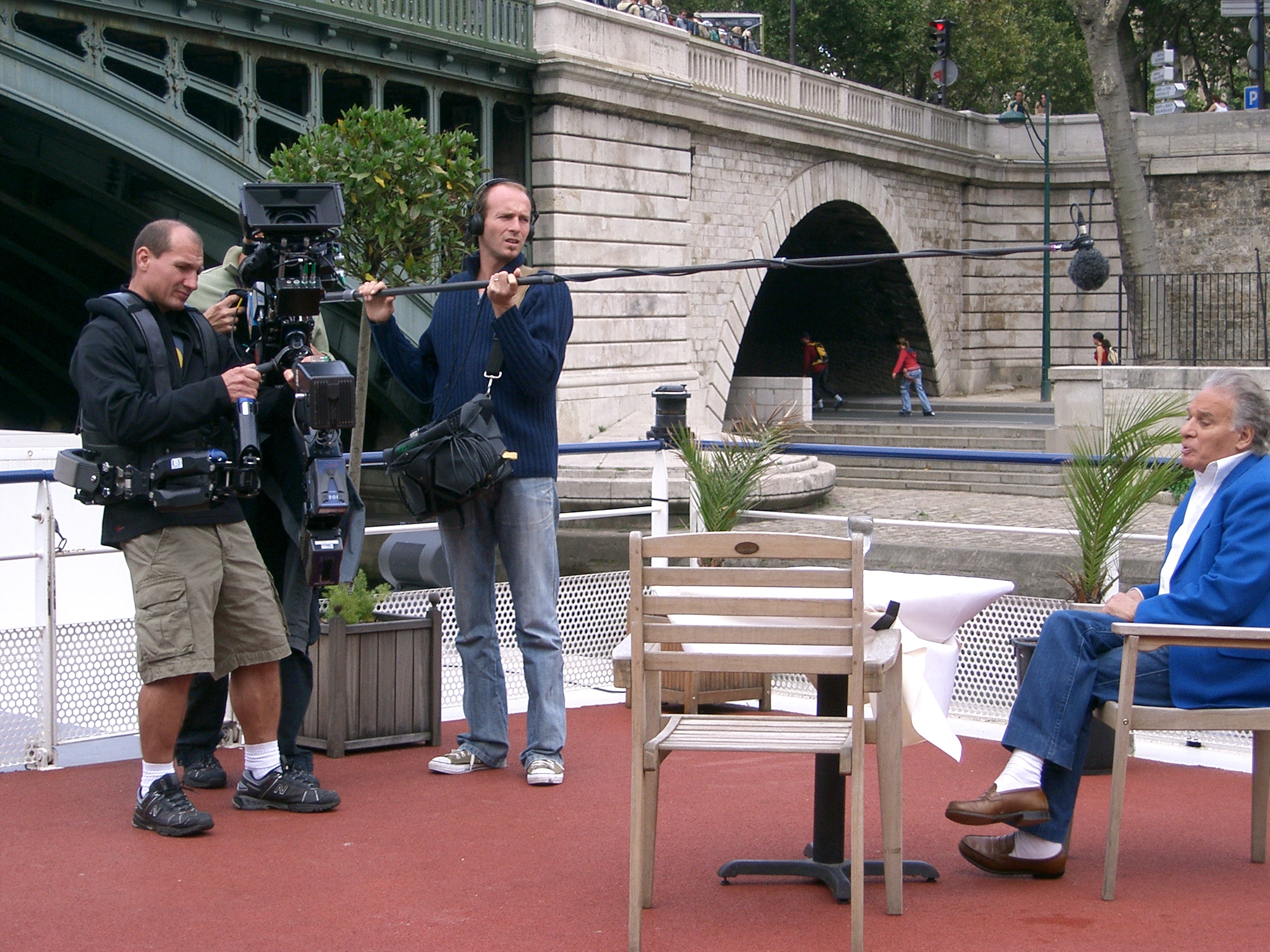
파리 센강의 배 위에서 붐 오퍼레이터가 두 손으로 붐폴을 들고, 옆의 카메라 오퍼레이터가 촬영 장비를 다룬다. 한 장면의 그림과 소리가 서로 다른 사람의 몸과 장비에 나뉘어 놓인 현장이다.PHOTO: PRA · CC BY-SA 3.0 · WIKIMEDIA COMMONS · DISPLAY CROP · SOURCE · CC BY-SA 3.0
배 위의 촬영팀이 한 장면을 준비한다. 카메라 오퍼레이터는 프레임을 만들고, 붐 오퍼레이터는 배우 쪽으로 마이크를 뻗는다.
카메라와 녹음기를 떼어놓은 순간, 누가 둘을 다시 만나게 했을까?
분리는 자유를 만들었다
Double-system은 그림과 소리를 별도 recorder에 기록하는 제작 구조다.[U238] 케이블 동기는 믿을 만했지만 sound recordist와 cameraman의 움직임도 묶었다. EBU는 군중 속에서 케이블에 사람이 걸리지 않게 거의 곡예하듯 움직여야 했다고 기록했다.[U237]
휴대형 1/4-inch tape recorder와 cable-free 동기 방식은 sound crew가 카메라와 떨어져 움직일 여지를 넓혔다. 별도 recorder라도 cable pilot을 쓰면 여전히 카메라와 케이블로 연결될 수 있었으므로, 매체의 분리만으로 이동성이 생긴 것은 아니다. 다큐멘터리와 시사 촬영은 더 가볍고 자유롭게 움직이는 장비를 원했고, 소리를 따로 기록하면 편집 선택도 넓어졌다.[U237][U240]
자유 뒤에는 주소가 필요했다
camera roll, sound roll, scene, take가 맞아야 했다. slate의 clap은 화면과 소리가 공유하는 한 순간을 만들었고, report와 label은 그 순간의 주소를 남겼다.[U240][U241]
camera assistant와 slate 담당자는 picture 식별을 맡았고, sound recordist는 소리와 sound roll을 지켰으며, boom operator는 프레임 밖에서 배우를 따라갔다.
double-system의 자유가 영화가 되려면 사람들은 두 매체가 같은 순간을 가리킨다는 증거를 끝까지 남겨야 했다.
EVIDENCE CONTEXT
이 페이지에서 사용한 근거
본문의 서사는 유지하고, 각 출처가 확인하는 내용과 한계를 먼저 보여 준다. English 원문과 출처는 펼쳐 확인할 수 있다.
U237
문맥 이해EBU의 동시대 기술 보고서는 별도 1/4-inch tape가 magnetic film으로 전사되는 구조와 cable 동기의 이동성 제약, tape의 slip·stretch 가능성을 함께 확인한다. 1973년 유럽 방송·film 기술 문맥의 검토이므로 모든 국가·장르의 double-system 운용이나 이후 crystal·timecode 체계까지 일반화할 수 없다.
원문·출처 보기
independent report
Review of existing systems for the synchronisation between film cameras and audio tape-recorders (EBU Tech 3095)
To provide greater flexibility in editing, the sound component is almost universally recorded on a separate audio tape-recorder and, for reasons of economy, bulk and technical quality, ¼-inch (6.25 mm) magnetic tape is generally adopted. However, this is only an intermediary, because the sound is subsequently transferred to a magnetic film of the same gauge as the picture film.
Nevertheless, there are disadvantages in using separate supports for the initial recording of picture and sound. While it is running, the magnetic tape may slip or stretch and the drive itself may not be constant.
The simplest and most reliable method of ensuring the synchronous working of a film camera and an audio tape-recorder consists of connecting them together by a cable which feeds to the tape-recorder signals representing the movement of the film in the camera. That system obviously has a considerable disadvantage from the operators’ point of view, that is to say, the lack of relative mobility.
원문 열기European Broadcasting Union · February 1973; rescanned OCR March 2006
U238
문맥 이해NFSA 용어집은 film 또는 video production에서 sound를 DAT나 Nagra 같은 별도 tape recorder에 기록하는 방식을 double system으로 정의한다. 짧은 glossary 정의이므로 역할 분담, 동기 방식, 전사 순서와 시대별 차이는 설명하지 않는다.
원문·출처 보기
other
Double system
Film or video production that utilizes sound recorded on a separate tape recorder, such as a DAT or Nagra.
원문 열기National Film and Sound Archive of Australia · publication date not stated; accessed 2026-09-28
U240
문맥 이해Britannica의 개요는 별도 사람이 별도 장치에 sound를 기록하면 유연성이 커지고 clapper의 접촉 순간이 picture와 sound 양쪽에 남는다고 설명한다. 후대 개요 자료이므로 국가별 도입 연대, 장비별 속도 유지, 현장의 실제 준수율은 확정하지 않는다.
Although it is possible to reproduce sound, either optically or magnetically, in the same camera that is photographing a scene (a procedure known as single-system recording), there is greater flexibility if the sound track is recorded by a different person and on a separate unit.
Double-system shooting requires a means of rematching corresponding sounds and images. The traditional solution is to mark the beginning of each take with a ‘clapper,’ or ‘clapstick,’ a set of wooden jaws about a foot long, snapped together in the picture field. The instant of clacking then is registered on both picture and sound tracks.
원문 열기Encyclopaedia Britannica · publication date not stated; accessed 2026-09-28
U241
문맥 이해Kodak의 제작 절차 자료는 roll 식별, slate, camera report와 exposed-film label의 일치를 하나의 정보 흐름으로 문서화한다. 2020년 후대 교육자료이므로 1950–70년대의 동시대 관행이나 모든 부서의 정확한 역할 분담을 입증하지 않는다.
원문·출처 보기
manual
Documenting your production made easy
1. Identify the roll. The first image of a new roll of film should be the slate. Identify the camera roll #, production title, date, director, and cinematographer.
5. Complete the camera report. Keep all camera activity recorded on your camera report. Be sure the information on your exposed film label matches the information on the camera report.
Slating requires diligence and is a very important step of the filmmaking process. Its purpose is to keep a consistent flow of information throughout production.
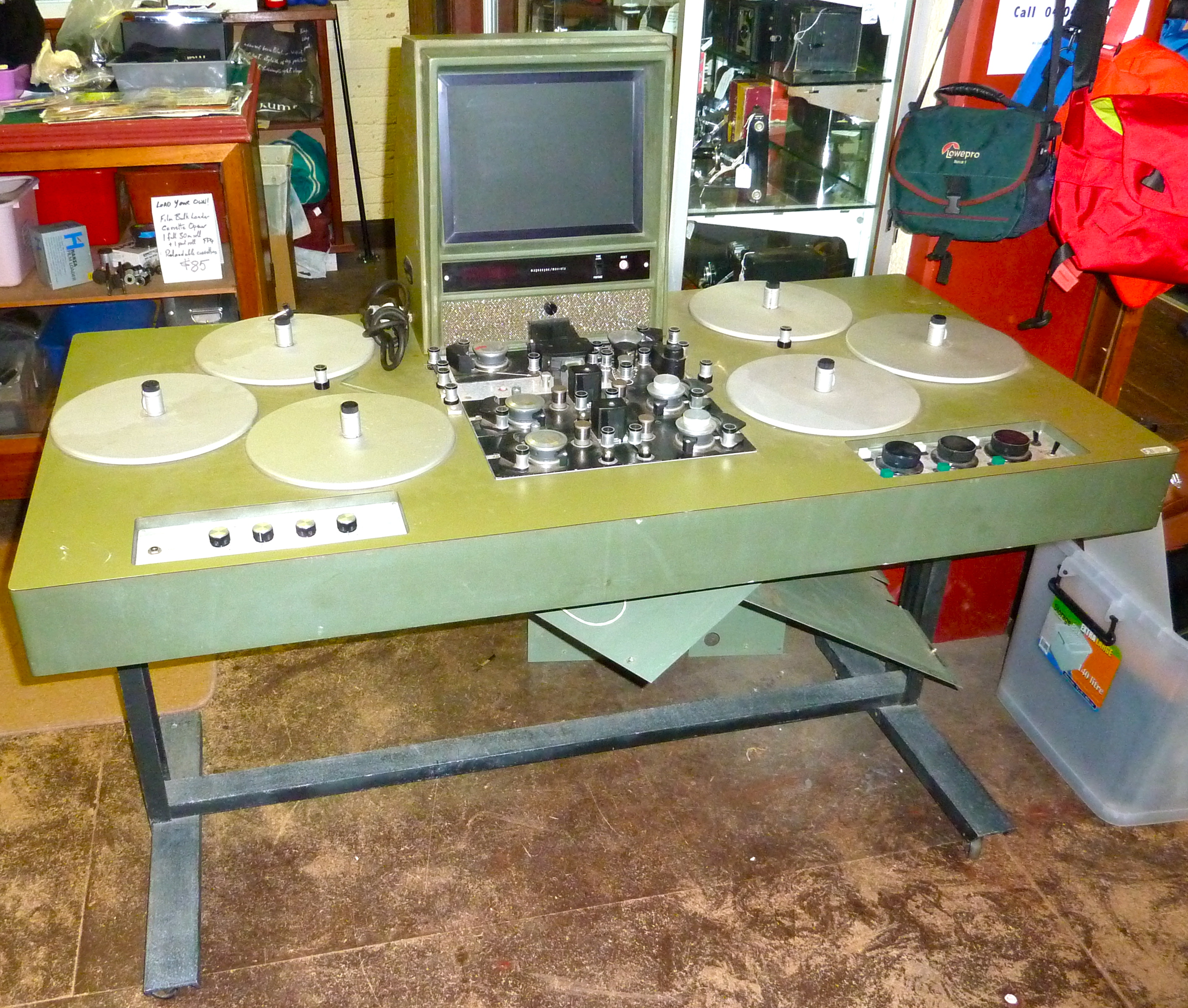
여러 platter와 roller, 화면과 transport control이 한 작업면에 모인 Moviola 16mm sound editing board. 사람은 프레임에 없지만 필름과 소리를 걸고 이동시키며 맞추던 편집 노동의 자리가 남아 있다.PHOTO: TANGERINEDUEL · CC BY-SA 4.0 · DISPLAY CROP · SOURCE · CC BY-SA 4.0
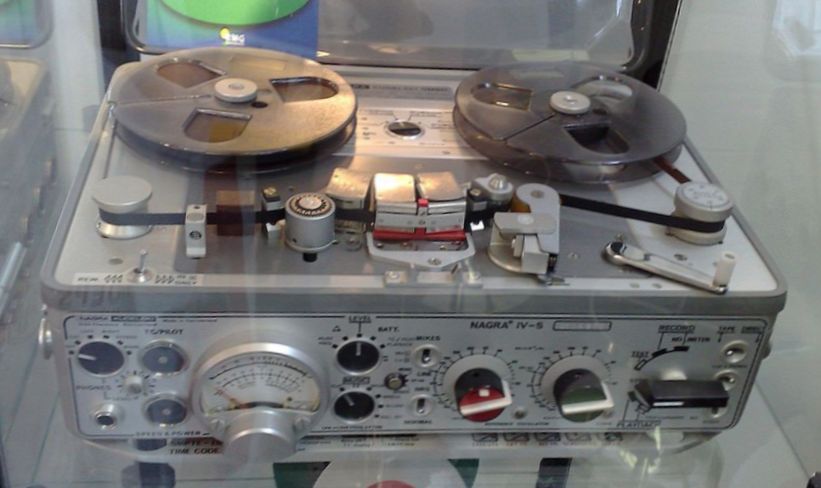
투명 덮개 아래 두 reel과 tape path가 드러난 Nagra IV-S 1/4-inch recorder. 실제 촬영 현장이나 record 상태로 특정하지 않는다.PHOTO: HENS ZIMMERMAN / OCTAVE.H · CC BY 2.0 · DISPLAY CROP · SOURCE · CC BY 2.0
촬영이 끝나면 camera negative와 sound tape는 다른 통에 담겼고, transfer operator는 1/4-inch tape를 걸어 picture와 함께 자를 수 있는 magnetic film으로 옮겼다.[U237][U244]
clap이 시작점을 알려 줬는데도, 왜 몇 분 뒤의 입 모양과 소리는 어긋날 수 있었을까?
한 점과 긴 시간은 다른 문제였다
별도로 도는 camera motor와 tape transport는 같은 속도를 영원히 유지하지 않았으며, tape는 미끄러지거나 늘어날 수 있었고 drive도 일정하지 않을 수 있었다.[U237] 1957년 1월 발행된 BBC Engineering Monograph No. 10은 같은 recorder로 기록하고 재생해도 몇 분 동안 sync를 실용 수준으로 유지하기 어려울 만큼 흐를 수 있다고 보고했다.[U243]
현장의 시간을 편집실의 길이로 옮기다
Pilot 계열 신호는 camera의 주행 속도와 관계된 기준을 tape에 남겼다. 후반 장비는 이를 읽어 sound film의 길이와 천공 수를 picture film에 맞췄다.[U237] Neopilot은 그 기준을 1/4-inch tape 중앙의 반대 위상 두 sync track에 기록한 특정 구현이었다.[U237][U245]
Nagra III의 작업면에는 battery meter, pilot 수신 표시, tape에 실제로 만들어진 기록을 듣는 monitoring이 함께 있었다.[U239] 기계가 확인을 없앤 것이 아니라 sound recordist가 후반의 시간을 미리 점검하게 했다.
한 현장 믹서는 짧은 reel 시간을 넘기려고 두 Nagra를 겹쳐 돌리고 overlap을 sound report에 적어 transfer house의 splicing에 의존했다고 회고했다.[U242] 한 사람의 사례이지 보편 규칙은 아니다.
Nagra가 사람을 동기 공정에서 없앤 것은 아니다. 현장 녹음기사가 후반의 시간을 준비하고 transfer operator와 editor가 그 관계를 이어받게 했다.
EVIDENCE CONTEXT
이 페이지에서 사용한 근거
본문의 서사는 유지하고, 각 출처가 확인하는 내용과 한계를 먼저 보여 준다. English 원문과 출처는 펼쳐 확인할 수 있다.
U237
문맥 이해EBU의 동시대 기술 보고서는 별도 1/4-inch tape가 magnetic film으로 전사되는 구조와 cable 동기의 이동성 제약, tape의 slip·stretch 가능성을 함께 확인한다. 1973년 유럽 방송·film 기술 문맥의 검토이므로 모든 국가·장르의 double-system 운용이나 이후 crystal·timecode 체계까지 일반화할 수 없다.
원문·출처 보기
independent report
Review of existing systems for the synchronisation between film cameras and audio tape-recorders (EBU Tech 3095)
To provide greater flexibility in editing, the sound component is almost universally recorded on a separate audio tape-recorder and, for reasons of economy, bulk and technical quality, ¼-inch (6.25 mm) magnetic tape is generally adopted. However, this is only an intermediary, because the sound is subsequently transferred to a magnetic film of the same gauge as the picture film.
Nevertheless, there are disadvantages in using separate supports for the initial recording of picture and sound. While it is running, the magnetic tape may slip or stretch and the drive itself may not be constant.
The simplest and most reliable method of ensuring the synchronous working of a film camera and an audio tape-recorder consists of connecting them together by a cable which feeds to the tape-recorder signals representing the movement of the film in the camera. That system obviously has a considerable disadvantage from the operators’ point of view, that is to say, the lack of relative mobility.
원문 열기European Broadcasting Union · February 1973; rescanned OCR March 2006
U239
문맥 이해Kudelski의 Nagra III manual은 15 ips 녹음에서 headphone monitoring과 보수적인 battery 판독을 요구하고 실제 tape에 만들어진 기록을 playback amplifier로 듣는 절차를 명시한다. 제조사 지침이므로 현장 준수율, 모든 Nagra variant의 pilot 구성, 실제 녹음 성공률은 확인하지 않는다.
원문·출처 보기
manual
Nagra III Instructions Manual
If one is recording at 15" / sec. always use monitoring headphones and read the battery meter pessimistically.
HI-FI RECORD = Normal recording position. The phones are connected to the play-back amplifier, so that the actual recording that has been made is monitored.
원문 열기Kudelski; Library of Congress preserved copy · May 1, 1963
U242
문맥 이해Jim Tanenbaum의 1인칭 회고는 5-inch reel의 짧은 runtime을 두 Nagra의 overlap, sound report 메모와 transfer-house splicing으로 관리한 사례를 기록한다. 작품·촬영 연도가 해당 passage에 없고 한 사람의 운용이므로 업계 전체의 표준 절차나 일반적인 reel 시간을 확정할 수 없다.
원문·출처 보기
practitioner recollection
My Godlike Reputation Part 2
Since the 7”-reel lid adapters weren’t available way back then, this helped me tremendously in dealing with the 15-minute runtime at 7½ IPS of the 5” tape reels. When I got near the end of the first reel, I just started the second machine to give some overlap, and then reloaded the first Nagra at my leisure. Unfortunately, calling for a tail slate caused too much confusion, so I had to note the overlap on sound reports and depend on the transfer house to handle the splicing. More unfortunately, the quarter-frame resolution of the magstripe sometimes caused a glitch at the splice, so I used the 2-recorder overlap only when absolutely necessary.
문맥 이해BBC의 동시대 시험 보고서는 같은 recorder로 기록·재생해도 몇 분 동안의 sync loss가 system을 사실상 쓸 수 없게 했고 drive·wear·capstan 열팽창에 따른 slippage를 원인 범위로 설명한다. 특정 10-minute reel 시험과 당시 machine 조건의 결과이므로 모든 recorder의 drift 크기나 모든 production workflow에 적용할 수 없다.
원문·출처 보기
independent report
BBC Engineering Monograph No. 10
It was found that although the tape was recorded and replayed on the same machine the loss of synchronism over a period of a few minutes made the system virtually unusable.
On the other hand if slippage does take place, as it invariably does owing to imperfect drive and wear and thermal expansion of the capstan, a phase drift occurs between the reference signal and the mains supply.
원문 열기BBC Engineering Division; World Radio History preserved OCR copy · January 1957
U244
문맥 이해Mary Jo Devenney의 1인칭 경력 회고는 작은 sound house에서 1/4-inch tape를 16 mm와 35 mm magnetic film으로 옮긴 transfer 노동을 직접 확인한다. 개인 경력의 한 구간이며 두 번째 sound-effect passage는 production dialogue sync가 아니므로 모든 double-system 전사 절차로 일반화할 수 없다.
원문·출처 보기
practitioner recollection
Life on the Frame Line
Back in LA, I couldn’t find a production job and wound up working at Richard Einfeld Productions, a little sound house. I did sound transfers, ¼” tape to 16 mag and 35 mag.
원문 열기IATSE Local 695 · publication date not stated; accessed 2026-09-28
U245
문맥 이해Science Museum Group의 소장품 기록은 Neopilot 장착 Nagra III가 1962년에 등장했고 late 1980s에 timecode가 preferred standard가 됐다고 요약한다. 박물관의 역사 개요이므로 최초 발명 우선권, 지역별 보급률, 모든 현장의 정확한 전환 시점은 확정하지 않는다.
원문·출처 보기
other
Nagra III Portable Tape Recorder
Stefan Kudelski introduced the “Neopilot” system and the first NAGRA III machines equipped with the system appeared in 1962.
"Neopilot" was the standard synchronization system used to synchronize sound and vision elements until the late 1980s, when time code became the preferred standard.
원문 열기Science Museum Group Collection · object dated 1958–1969; page accessed 2026-09-28
U237 · U239 · U242 · U243 · U244 · U245
03 · FRAME ADDRESS · HUMAN CONTEXT047
047
FRAME ADDRESS · HUMAN CONTEXT
주소는 기계가 남겼지만, 그 뜻은 사람이 적었다
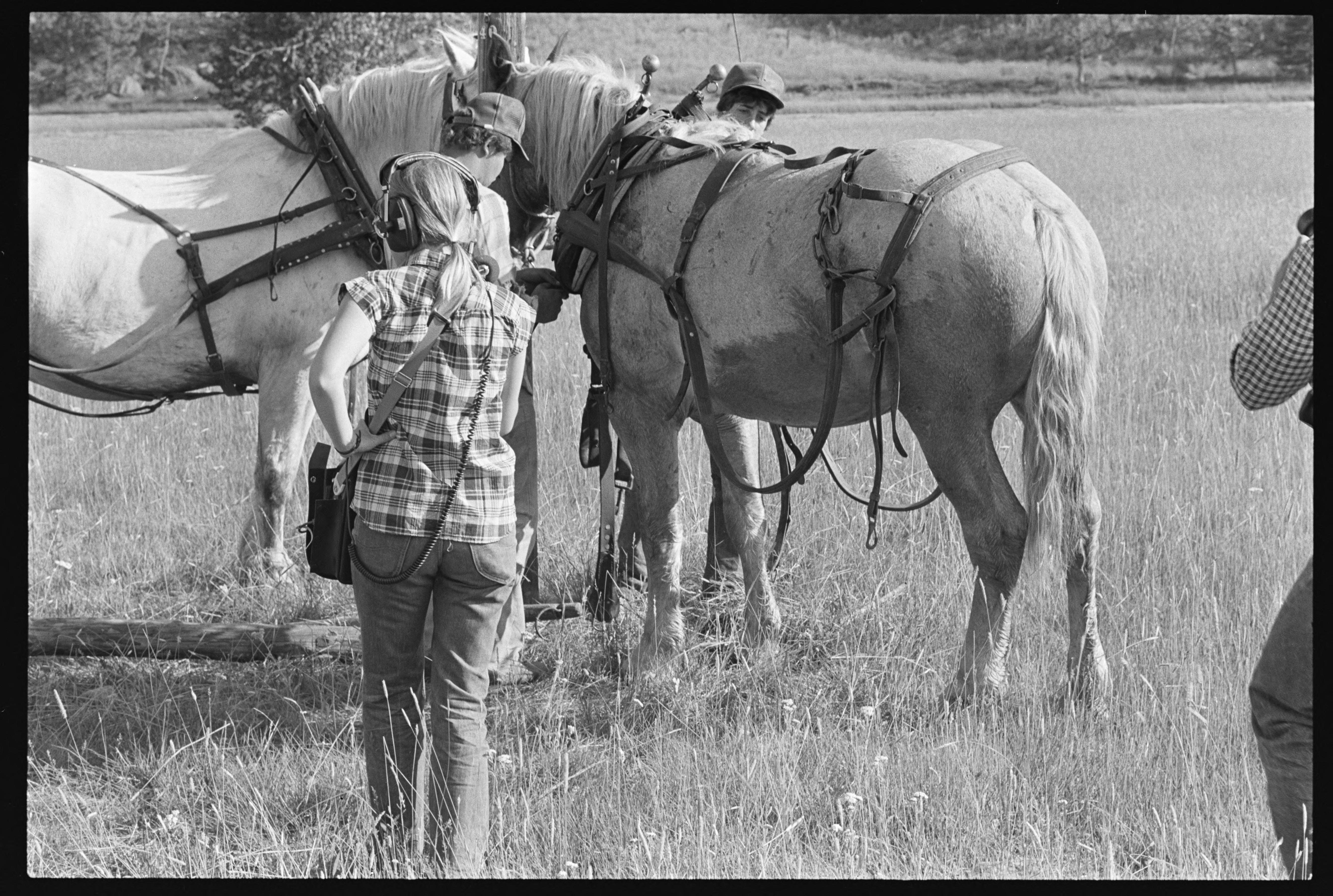
1979년 몬태나 현지조사에서 헤드폰을 쓰고 Nagra tape recorder로 소리를 기록하는 fieldworker Paula Johnson. 정확한 Nagra 모델, Neopilot·timecode 사용 여부와 tape transport 상태는 사진만으로 특정하지 않는다.PHOTO: GARY WARD STANTON · MONTANA FOLKLIFE SURVEY COLLECTION · LIBRARY OF CONGRESS · DISPLAY CROP · SOURCE
말 두 마리가 서 있는 들판에서 Paula Johnson은 헤드폰을 쓰고 녹음 가방을 멘다. 사진은 영화 세트가 아니라 1979년의 현지조사 장면이다. 무엇을 기록할지는 장비의 숫자가 아니라 그 자리에 선 사람이 정했다.[U258]
속도를 맞출 기준이 프레임 주소로 바뀌면, 사람의 일은 줄어들었을까?
속도 기준 다음에 프레임 주소가 왔다
앞 스프레드의 pilot은 후반 전사에서 picture와 sound의 길이 관계를 맞출 기준을 tape에 남겼다.[U237] Timecode는 film과 sound에 같은 frame 주소를 기록해 위치를 찾고 대조하는 일을 줄였다. Nagra IV-S 계열에서도 pilot형과 timecode형은 공존했다.[U246][U247]
같은 숫자도 사람이 준비했다
운용자는 recorder의 frame rate와 timecode mode를 정하고 master source에서 다른 장비를 jam한 뒤 slate와 recorder의 rate·표시를 대조했다.[U248][U249] Display가 실패할 때를 대비한 conventional clap도 남았다.[U249]
주소에는 제작의 뜻이 없었다
01:14:23:08은 한 frame을 찾게 하지만 어느 production unit, scene, take, roll인지 말하지 않는다. Slate와 report는 주소에 식별 정보와 예외를 붙여 후반에 넘겼다.[U250][U255]
Timecode는 위치를 찾는 반복 노동을 줄였다. 사람의 책임은 rate·jam·주소·예외·인계 관리로 이동했다.
EVIDENCE CONTEXT
이 페이지에서 사용한 근거
본문의 서사는 유지하고, 각 출처가 확인하는 내용과 한계를 먼저 보여 준다. English 원문과 출처는 펼쳐 확인할 수 있다.
U237
문맥 이해EBU의 동시대 기술 보고서는 별도 1/4-inch tape가 magnetic film으로 전사되는 구조와 cable 동기의 이동성 제약, tape의 slip·stretch 가능성을 함께 확인한다. 1973년 유럽 방송·film 기술 문맥의 검토이므로 모든 국가·장르의 double-system 운용이나 이후 crystal·timecode 체계까지 일반화할 수 없다.
원문·출처 보기
independent report
Review of existing systems for the synchronisation between film cameras and audio tape-recorders (EBU Tech 3095)
To provide greater flexibility in editing, the sound component is almost universally recorded on a separate audio tape-recorder and, for reasons of economy, bulk and technical quality, ¼-inch (6.25 mm) magnetic tape is generally adopted. However, this is only an intermediary, because the sound is subsequently transferred to a magnetic film of the same gauge as the picture film.
Nevertheless, there are disadvantages in using separate supports for the initial recording of picture and sound. While it is running, the magnetic tape may slip or stretch and the drive itself may not be constant.
The simplest and most reliable method of ensuring the synchronous working of a film camera and an audio tape-recorder consists of connecting them together by a cable which feeds to the tape-recorder signals representing the movement of the film in the camera. That system obviously has a considerable disadvantage from the operators’ point of view, that is to say, the lack of relative mobility.
원문 열기European Broadcasting Union · February 1973; rescanned OCR March 2006
U246
문맥 이해EBU code는 독립 generator가 충분히 안정되고 촬영일 시작 전에 동기화되면 지속적인 camera-recorder 연결 없이 공통 timecode를 사용할 수 있다고 설명한다. 이는 안정된 generator와 사전 synchronization을 전제로 한 기술 code이므로 timecode 단독의 clock lock이나 현장 설정의 정확성을 보증하지 않는다.
원문·출처 보기
independent report
EBU Code for the Synchronization Between Film Cameras and Audio Tape-Recorders (Tech 3096-E)
If a unique time code is recorded on the film in the camera to indicate the start of each separate second and if the same time code is simultaneously recorded on the magnetic tape of the sound recorder, subsequent picture-sound synchronization can be achieved simply by matching the time codes on the film and the tape.
If sufficiently stable generators are used in the cameras and the sound recorder, and if they are synchronized before the start of a day's shooting, then no other synchronizing connection of any kind is needed between the cameras and the sound recorder.
원문 열기European Broadcasting Union · Third edition, March 1985
U247
문맥 이해Nagra의 공식 archive는 IV-S의 중앙 track이 기종에 따라 pilot 또는 timecode에 쓰였고 NAGRASYNC와 SMPTE/EBU option이 구분됐다고 설명한다. 현행 제조사 archive이므로 각 variant의 최초 판매일, 현장 보급률, 모든 IV-S의 동일 구성을 확정하지 않는다.
원문·출처 보기
official retrospective
Nagra IV Family
The NAGRA IV-S is a portable stereo 6.35-mm (¼ inch) analogue audio tape recorder designed for high quality musical recording and for cinema and television applications. It has two 2-mm audio tracks and a central track for pilot or time code uses depending on the machine type.
The machine can be fitted with either the NAGRASYNC pilot option or the SMPTE/EBU 80 bits time code option, and may also be powered from either an external supply (ATN-4) or internal batteries.
원문 열기Nagra Audio · current official archive; publication date not stated
U248
문맥 이해Sound Devices의 744T guide는 timecode workflow에서 올바른 setup이 정확성에 필수이며 744T를 clock source로 쓸 때 다른 장비에 jam하라고 지시한다. 후대 특정 recorder의 제조사 manual이므로 1980년대 timecode 관행이나 모든 장비 조합의 동기 성능을 입증하지 않는다.
원문·출처 보기
manual
Sound Devices 744T User Guide
When using a time code workflow, proper time code setup is essential for accuracy.
Use the 744T as the clock source and jam time code to all other recording devices. This will assure that every device is using the same time reference.
문맥 이해Denecke manual은 slate와 tape machine의 frame rate 일치, production 전체의 code type 유지, sound report의 frame-rate 기록과 conventional clap backup을 요구한다. 특정 Dcode slate 세대의 지침이므로 모든 slate와 제작의 jam 주기나 오류율을 일반화할 수 없다.
원문·출처 보기
manual
Dcode Time Code Slate Instructions
The frame rate of the slate should match the frame rate of the tape machine’s time code.
Use same type of code for the entire production (non-drop preferred) and indicate the frame rate on the sound report.
The conventional “clapper sync” is a back up feature.
문맥 이해Kodak 자료는 camera report가 rolls·takes·scene numbers를 기록하고 picture와 독립된 sound roll을 sync 목적으로 적어야 한다고 설명한다. Camera-department 중심의 2020년 교육자료이므로 sound department 내부 분업이나 과거 모든 production의 양식을 확정하지 않는다.
원문·출처 보기
manual
Documenting your production made easy
Completing a camera report is standard protocol in professional cinematography. It provides a concise record of all your camera activity: rolls, takes, filters, scene numbers, and other data recorded during production.
The sound roll, independent of picture, is typically DAT or 1/4” tape. It is important to note for syncing purposes.
문맥 이해SMPTE 표준은 frame-based system의 time address를 discrete frame을 식별하는 label로 정의한다. 표준의 주소 정의만으로 generator lock, genlock, word clock, 올바른 frame-rate 설정이나 drift 방지를 확정할 수 없다.
원문·출처 보기
manual
SMPTE ST 12-1:2008 — Time and Control Code
For frame-based systems the time address that forms part of the time code is primarily intended as a label to identify discrete frames.
원문 열기Society of Motion Picture and Television Engineers · 2008
U255
문맥 이해Glen Trew의 실무 권고는 DAT cassette를 recorder에 넣기 전에 label을 붙이고 sound report 세 부를 tape·production office·recordist에게 나누는 인계 절차를 기록한다. 오래된 practitioner guidance이며 권고문이므로 실제 준수율, 모든 제작의 report 양식, 자동화되지 않은 오류의 빈도는 확정하지 않는다.
원문·출처 보기
practitioner recollection
Things You May Not Learn In Film School (but should)
In the case of DAT recording, always label the cassette before inserting in into the recorder. The 15 seconds this takes can seem like an eternity, especially if you have not prepared, but it’s nothing compare to the torture of wondering if you are recording over the previous scene.
Always include a ‘Sound Report’ in triplicate.
One copy goes to with the tape to the transfer house, another is for the production office records, the third stays with you (always).
원문 열기Trew Audio · legacy practitioner guidance; page note current in 2014
U258
문맥 이해LOC visual record와 승인된 rights ledger는 1979년 Montana 현지조사에서 fieldworker Paula Johnson이 headphone을 쓰고 Nagra tape recorder로 소리를 기록하는 장면을 확인한다. 사진만으로 정확한 Nagra model, Neopilot·timecode 사용, tape transport 상태와 녹음 결과는 확정할 수 없다.
원문·출처 보기
visual record
Johnny Senecal ranch — Paula Johnson recording with a Nagra
1979년 몬태나 현지조사에서 헤드폰을 쓰고 Nagra tape recorder로 소리를 기록하는 fieldworker Paula Johnson.
원문 열기American Folklife Center, Library of Congress · 1979-07-19
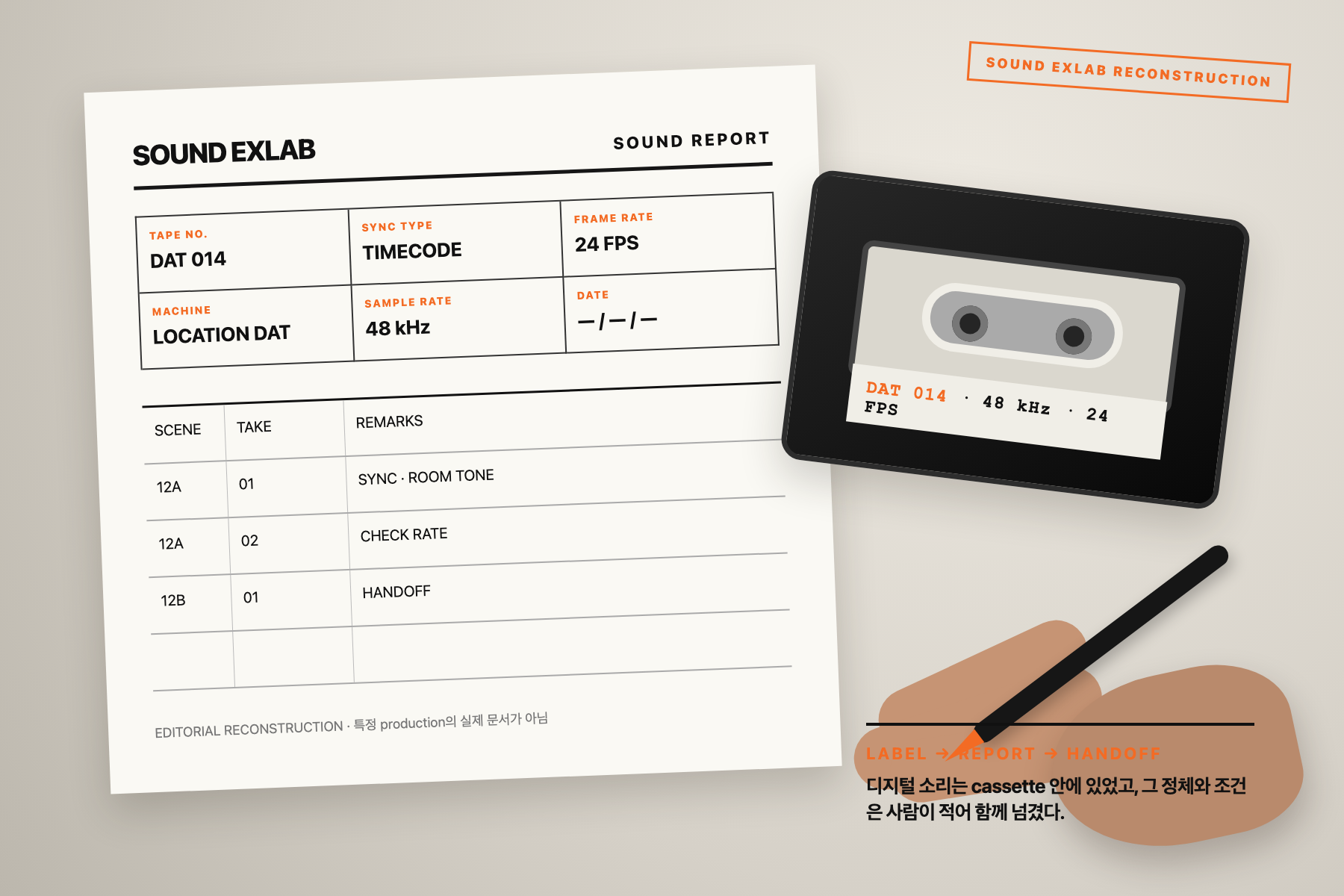
DAT cassette를 넣기 전 label을 쓰고 tape number·sync type·frame rate를 report와 함께 확인하는 인계 절차의 편집 재구성. 특정 production의 실제 문서나 Fostex PD-4 작업대를 재현한 것이 아니다.SOUND EXLAB / HERMES · EDITORIAL RECONSTRUCTION · DISPLAY CROP ·
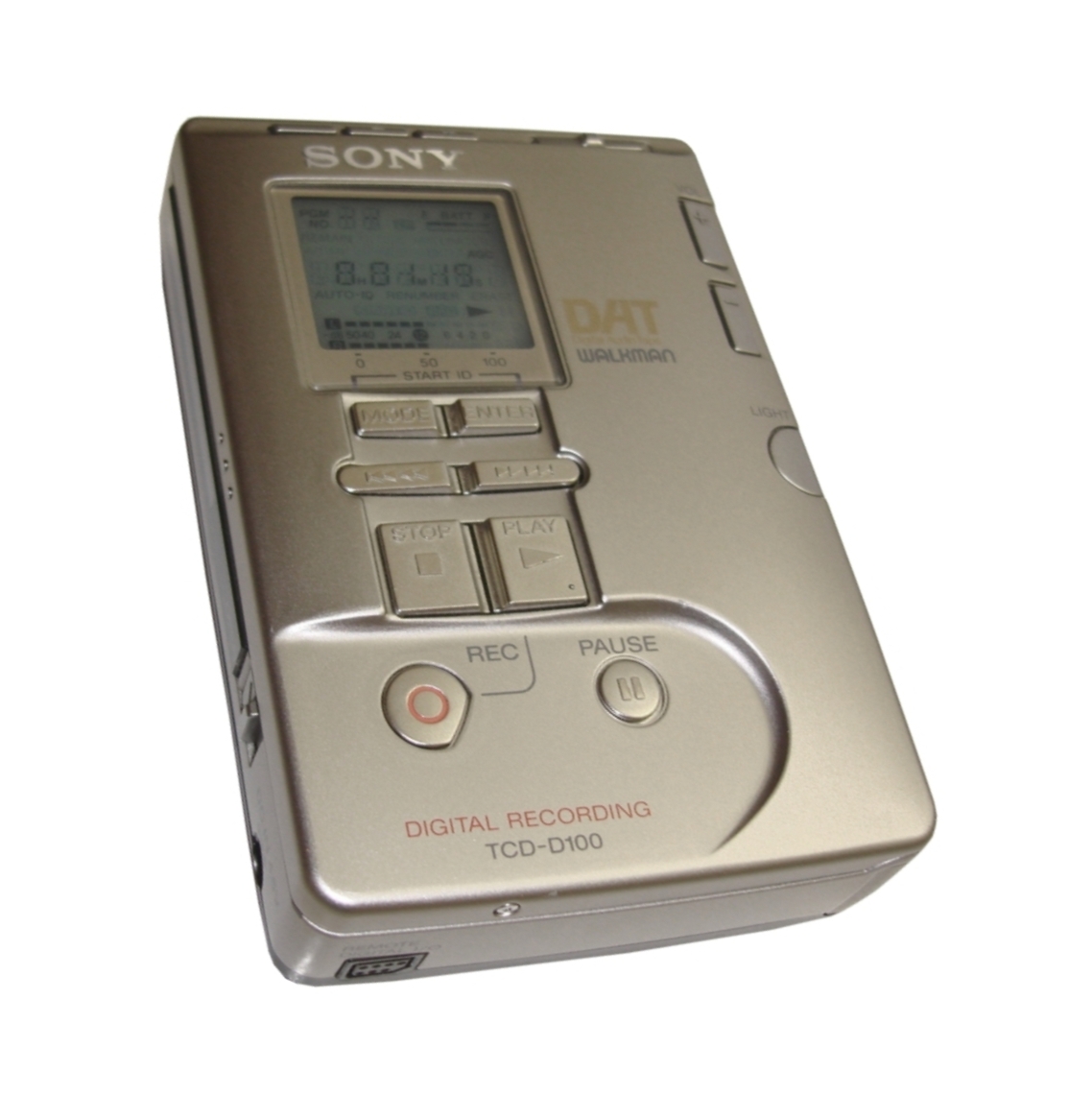
약 1998년의 Sony TCD-D100 portable DAT recorder. 작은 물리 cassette에 digital audio를 기록한 DAT 형식의 예시이며, 영화 현장의 professional timecode DAT 증거는 아니다.PHOTO: PITTIGRILLI · WIKIMEDIA COMMONS · CC0 1.0 · DISPLAY CROP · SOURCE · CC0 1.0
녹음기는 아직 열려 있다. Sound recordist는 DAT cassette를 넣기 전에 작은 label부터 쓴다. 이미 녹음된 cassette를 새 tape로 착각하지 않기 위해서다.[U255]
소리가 digital로 기록되면, 촬영 뒤의 인계도 곧바로 file이 되었을까?
디지털은 파일보다 먼저 테이프에 왔다
Fostex PD-4 같은 일부 location DAT recorder는 timecode 운용, jam sync와 confidence monitoring을 결합했다. Confidence mode는 input이 아니라 tape에서 돌아오는 기록 신호를 들려주었다.[U256][U260] 그러나 DAT는 digital file storage가 아니라 digital magnetic tape였다. 일부 professional DAT만 timecode와 Start ID를 지원했다.[U253]
카세트와 종이가 함께 움직였다
Cassette label과 sound report에는 tape number·sync type·frame rate 같은 조건이 담겨 매체와 함께 transfer house로 전달됐다.[U255] Transfer operator는 label과 report를 대조한 뒤 deck을 재생해 ingest를 시작했다.
복사는 디지털이었지만 시간은 선형이었다
대부분의 audio-specific tape format은 real time보다 빠른 upload가 어려웠다.[U252] 수십 년 뒤 보존 ingest에는 dropout, deck compatibility, 부품 부족과 시설별 QC 절차가 새로운 제약으로 남았다.[U251][U257]
DAT가 digital로 바꾼 것은 신호의 표기였다. 그러나 매체를 식별하고, 재생시간 동안 옮기며, 오류를 판정하는 사람의 시간은 남았다.
EVIDENCE CONTEXT
이 페이지에서 사용한 근거
본문의 서사는 유지하고, 각 출처가 확인하는 내용과 한계를 먼저 보여 준다. English 원문과 출처는 펼쳐 확인할 수 있다.
U251
문맥 이해NARA의 보존 지침은 DAT가 시간 경과에 따라 data dropout과 machine compatibility error를 보였고 format obsolescence로 지원과 부품 확보가 어려워졌다고 설명한다. 장기 보존 관점의 현행 지침이므로 제작 당시의 음질, 채택률, 개별 cassette의 상태를 판정하지 않는다.
원문·출처 보기
other
Audio Guidance: Important Characteristics of Audio Formats
DAT has a base and magnetic layer and is primarily polyester based. DAT tapes have proven to be fairly unstable over time, exhibiting data dropouts and compatibility errors between machines. In addition, the format is deemed obsolete making it difficult to find support and parts from manufacturers and service providers.
원문 열기U.S. National Archives and Records Administration · publication date not stated; accessed 2026-09-28
U252
문맥 이해IASA 지침은 signal transfer가 보통 recorded segment의 running time보다 조금 더 걸리고 대부분의 audio-specific tape-based digital format은 real time보다 빠른 upload를 허용하지 않는다고 설명한다. 보존 지침은 예외가 있음을 명시하므로 모든 DAT가 정확히 1배속이며 준비·metadata 작업 시간이 같다고 단정할 수 없다.
원문·출처 보기
other
IASA TC-04 — 5.5.11 Time Factor
Signal transfer is generally slightly more than actual running time for each recoded segment, and time taken for management of metadata and materials management will depend on details of the archiving system in use. Most audio specific tape based digital recording formats do not allow upload of the data at greater than real time, with the exception of those mentioned above.
원문 열기International Association of Sound and Audiovisual Archives · current web edition; accessed 2026-09-28
U253
문맥 이해Sony manual은 PCM-7050/7030 tape의 subcode 영역에서 SMPTE/EBU timecode를 기록·읽을 수 있고 Start ID로 high-speed search가 가능하다고 문서화한다. 특정 professional model과 option의 기능이므로 모든 DAT, scene·take metadata, file-like random access로 확대할 수 없다.
원문·출처 보기
manual
PCM-7050/7030 Operation Manual
The tape used for the PCM-7050/7030 has subcode areas where you can record or read SMPTE/EBU time code.
The PCM-7050/7030 has an ID code function peculiar to DATs. The use of a Start ID, for example, makes it possible to carry out a highspeed search operation.
원문 열기Sony; eServiceInfo preview copy · 3rd edition; publication date not stated
U255
문맥 이해Glen Trew의 실무 권고는 DAT cassette를 recorder에 넣기 전에 label을 붙이고 sound report 세 부를 tape·production office·recordist에게 나누는 인계 절차를 기록한다. 오래된 practitioner guidance이며 권고문이므로 실제 준수율, 모든 제작의 report 양식, 자동화되지 않은 오류의 빈도는 확정하지 않는다.
원문·출처 보기
practitioner recollection
Things You May Not Learn In Film School (but should)
In the case of DAT recording, always label the cassette before inserting in into the recorder. The 15 seconds this takes can seem like an eternity, especially if you have not prepared, but it’s nothing compare to the torture of wondering if you are recording over the previous scene.
Always include a ‘Sound Report’ in triplicate.
One copy goes to with the tape to the transfer house, another is for the production office records, the third stays with you (always).
원문 열기Trew Audio · legacy practitioner guidance; page note current in 2014
U256
문맥 이해Glen Trew의 practitioner article은 PD-4 confidence return의 지연된 소리가 tape가 끝나거나 실제 roll하지 못한 경험이 있는 작업자에게 기록 확인 수단이 됐다고 설명한다. 특정 recorder에 대한 개인 평가이므로 모든 DAT의 monitoring 구조, 오류 검출률과 현장 신뢰성을 확정하지 않는다.
원문·출처 보기
practitioner recollection
The Venerable Fostex PD-4 Timecode DAT Recorder
While this delayed sound is disconcerting to the novice, it is certainly confidence inspiring for those who have run out of tape or thought they rolling when they weren’t.
원문 열기Trew Audio · publication date not stated; accessed 2026-09-28
U257
문맥 이해Smithsonian 보고서는 DAT conversion이 real time으로 진행돼야 했고 AES/EBU digital connection을 권장했으며 dropout과 zipper가 대표 오류라고 기록한다. 한 기관의 보존 pilot과 archival transfer 문맥이므로 촬영 당시 production handoff나 모든 facility의 QC 절차로 일반화할 수 없다.
원문·출처 보기
independent report
Digital Audio Tape Preservation
The conversion of DATs also must occur in real time, causing the process to be quite time consuming depending on the number of tapes to be converted.
It is best to transfer by the latter using an AES/EBU digital connection.
The most common errors for DATs are drop-outs (mutes) and zippers (strings of small errors). These are usually very noticeable.
문맥 이해승인된 visual ledger는 Sony TCD-D100 portable DAT recorder의 단독 제품 사진이 작은 DAT cassette 형식과 휴대형 장치의 외형을 보여 준다고 확인한다. 사진에는 사람·tape 삽입·영화 현장·timecode workflow가 없으므로 professional production 사용이나 본문 사례의 장비로 확정할 수 없다.
원문·출처 보기
visual record
Sony TCD-D100 DAT-Recorder Walkman
약 1998년의 Sony TCD-D100 portable DAT recorder. DAT의 작은 물리 cassette 형식을 보여 주는 예시.
문맥 이해Fostex manual은 PD-4의 four-head confidence monitoring, SMPTE/EBU timecode record·playback과 crystal-clock generator를 문서화한다. 보존 text copy의 특정 model manual이므로 다른 DAT recorder의 기능, tape 오류 검출 성공률이나 file workflow를 입증하지 않는다.
원문·출처 보기
manual
PD-4 Owner’s Manual
Four-head design allows confidence monitoring (simultaneous recording and playback) of audio data.
Record and playback capabilities of SMPTE/EBU time code, IEC format.
The PD-4 generates time code using a crystal clock. This offers improved flexibility in time code applications, allowing independent operation of the unit.
원문 열기Fostex; Internet Archive preserved text copy · manual date not stated
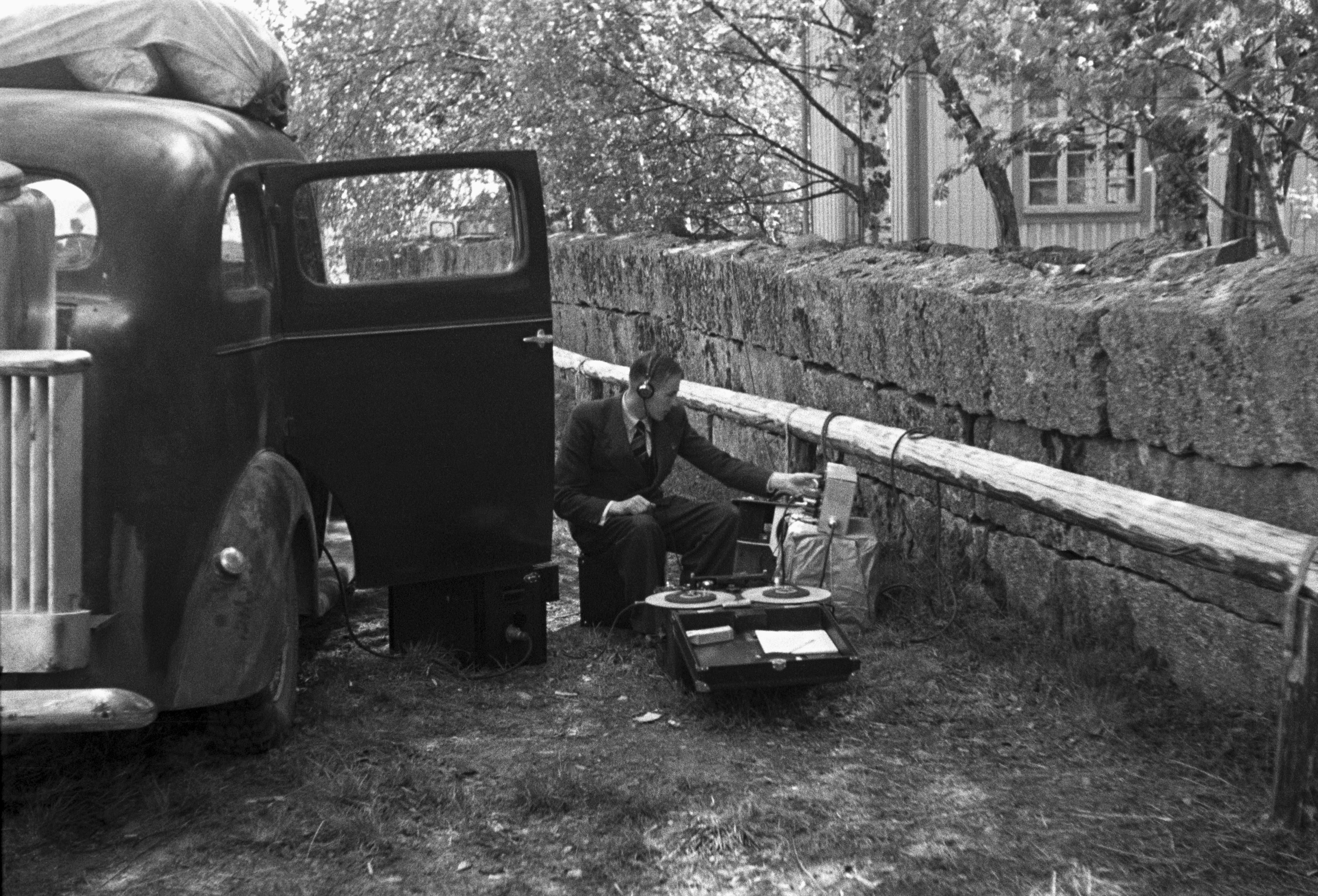
1939년 6월, 핀란드 Yle 음향차 옆에서 한 작업자가 릴 장비를 다룬다. 1974년 Nashville 전사실이나 DAT workflow의 기록은 아니다.PHOTO: YLE ARCHIVES · PUBLIC DOMAIN / NO KNOWN COPYRIGHT RESTRICTIONS · DISPLAY CROP · SOURCE
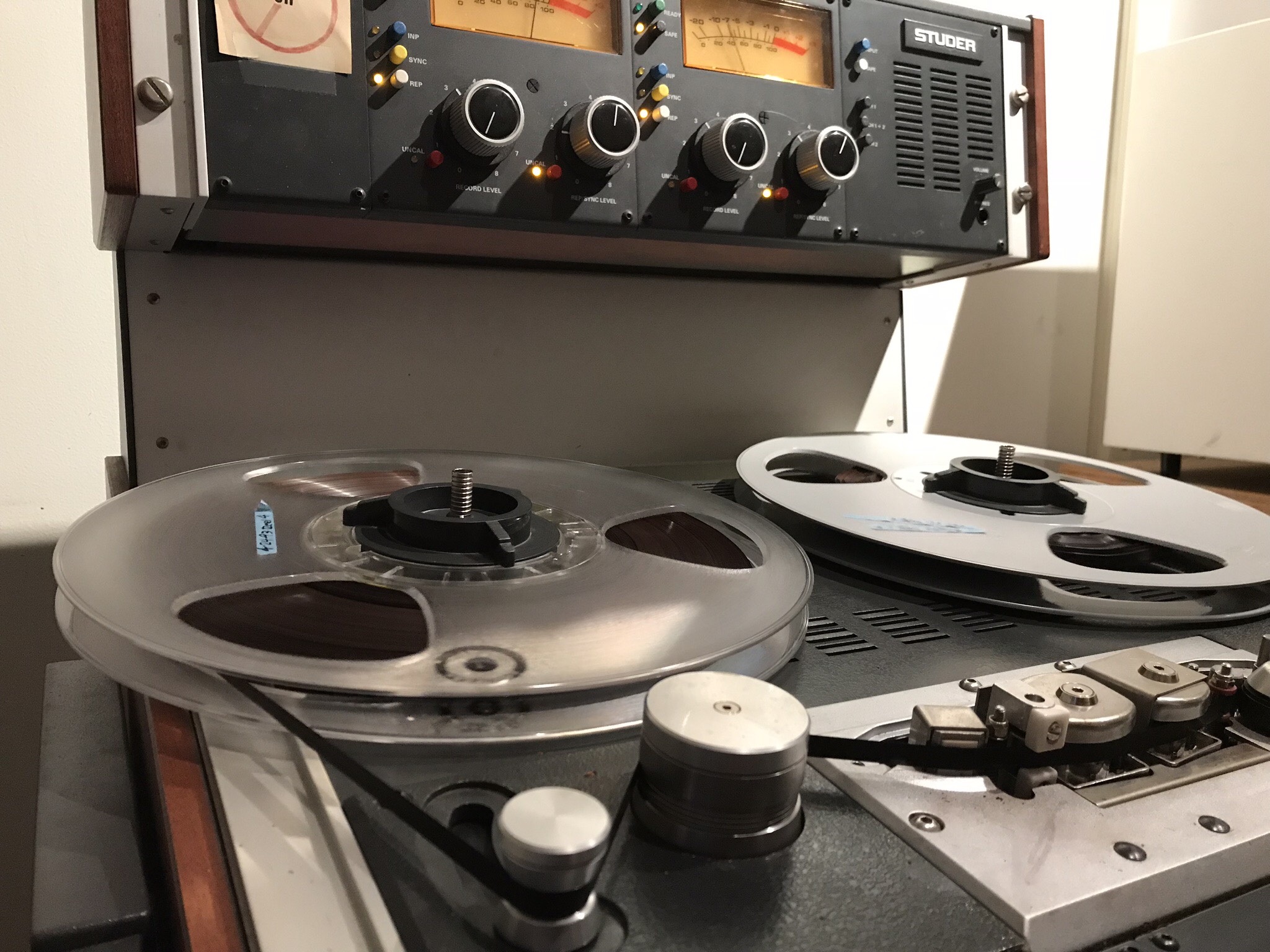
1/4인치 아날로그 테이프가 Studer A810의 릴과 헤드 경로를 지난다. 원 출처는 digitization 재생 장면으로 설명한다.PHOTO: SAUERKRAUTROCK · CC BY-SA 4.0 · DISPLAY CROP · SOURCE · CC BY-SA 4.0
1974년 여름, 영화 《Nashville》 제작진이 머문 Nashville의 motel transfer room이다.
낮 촬영이 끝나면 Fred Schultz의 밤이 시작됐다. 운송 담당자는 Stevens 1인치 8트랙 녹음기와 촬영 테이프, 믹서 Jim Webb의 지시가 적힌 기록지를 가져왔다. Schultz는 여덟 트랙 가운데 지정된 세 트랙을 골라 구멍이 있는 세 줄짜리 마그네틱 필름에 옮겼다.[U271]
ATTRIBUTED EXPERIENCE · DAT 이야기가 아니다. 한 사람의 1974년 영화 dailies 전사 경험이며 모든 tape production의 표준 절차가 아니다.
카메라가 멈춘 뒤, 편집실에서 들을 수 있는 소리를 만들기 위한 두 번째 작업이 시작됐다.
두 번째 기록에 붙은 사람의 판단
Schultz는 기록과 다르게 한 마이크 트랙을 세 줄 모두에 복사했고, 이틀 밤 뒤 일일 시사본에서 반주가 사라진 것을 알게 됐다.[U271] 기계를 돌리는 일과 어떤 트랙을 넘길지 판단하는 일은 떨어져 있지 않았다.
왜 random access가 필요했나
Audio-specific tape에서는 신호가 디지털이어도 매체를 재생해야 소리를 꺼낼 수 있었다.[U252] 하드디스크 녹음은 되감기 없이 원하는 위치를 읽을 수 있었다.[U261] 필요한 위치를 바로 읽는 파일 녹음은 음질보다, 소리를 꺼내기 위해 매체 길이만큼 다시 재생하던 의존을 줄이는 선택이었다.[U264]
전환은 한 번의 교체가 아니었다. Beau Baker가 회고한 2005년 한 TV 시리즈에서는 CF 카드·DVD-RAM·DAT 백업 테이프가 함께 인계됐다.[U069]
밤의 두 번째 기록은 짧아졌다. 그러나 다음 사람이 받을 소리를 확인하는 일은 끝나지 않았다.
EVIDENCE CONTEXT
이 페이지에서 사용한 근거
본문의 서사는 유지하고, 각 출처가 확인하는 내용과 한계를 먼저 보여 준다. English 원문과 출처는 펼쳐 확인할 수 있다.
U069
문맥 이해Beau Baker의 장기 TV series 회고는 2005년에 CF card·DVD-RAM·DAT backup tape를 함께 넘긴 구성과 이후 CF card를 post house에서 복사·반환·재사용한 시기를 구분해 기록한다. 한 mixer와 한 series의 장기 기억이므로 두 시점을 같은 2005년 절차로 합치거나 업계 전체의 전환 순서로 일반화할 수 없다.
원문·출처 보기
practitioner recollection
Is That Show Still On?
To begin this rambling saga, 2005: I had a HHB Portadat and a Sound Devices 744. I turned in the CF card and the DVD-RAM, plus the DAT ‘backup’ tape.
The digital tape recorded in a linear fashion, so transferring the audio was a ‘real time’ affair: a five-minute take took five minutes to transfer. The cassettes were fragile, and prone to mechanical failure after storage.
The CF cards were sent to the post house, copied, and returned to be reformatted and used again.
원문 열기IATSE Local 695 · publication date not stated
U252
문맥 이해IASA 지침은 signal transfer가 보통 recorded segment의 running time보다 조금 더 걸리고 대부분의 audio-specific tape-based digital format은 real time보다 빠른 upload를 허용하지 않는다고 설명한다. 보존 지침은 예외가 있음을 명시하므로 모든 DAT가 정확히 1배속이며 준비·metadata 작업 시간이 같다고 단정할 수 없다.
원문·출처 보기
other
IASA TC-04 — 5.5.11 Time Factor
Signal transfer is generally slightly more than actual running time for each recoded segment, and time taken for management of metadata and materials management will depend on details of the archiving system in use. Most audio specific tape based digital recording formats do not allow upload of the data at greater than real time, with the exception of those mentioned above.
원문 열기International Association of Sound and Audiovisual Archives · current web edition; accessed 2026-09-28
U261
문맥 이해Avid guide는 hard-disk recording을 원하는 지점으로 바로 이동하는 nonlinear 또는 random-access medium으로, tape를 rewind·fast-forward가 필요한 linear medium으로 대비한다. 2011년 후대 교육자료이므로 초기 field recorder 채택의 동시대 동기나 모든 storage 작업의 무지연을 입증하지 않는다.
원문·출처 보기
manual
Pro Tools Reference Guide v10.1
Hard disk recording is a nonlinear (or random access) medium—you can go immediately to any spot in a recording without having to rewind or fast forward.
This differs from tape-based recording, which is a linear medium—where you need to rewind or fast forward to hear a particular spot in a recording. To rearrange or repeat material in a linear system, you need to re-record it, or cut and splice it.
문맥 이해IASA 지침은 digital audio를 관리·유지하려면 computer가 인식하는 WAV·BWF·AIFF 같은 standard data format으로 변환해야 한다고 설명한다. 보존 목적의 현행 지침이므로 영화 현장의 최초 도입 동기, host system의 완전한 오류 복구나 자동 장기보존을 보증하지 않는다.
원문·출처 보기
other
IASA TC-04 — 6.1.2 Data or Audio Specific Storage
To effectively manage and maintain digital audio it is necessary to transform it to a standard data format. Data formats are the file types, such as .wav, BWF, or AIFF, which computer systems recognise.
원문 열기International Association of Sound and Audiovisual Archives · current web edition
U271
문맥 이해Fred Schultz의 1인칭 회고는 1974년 *Nashville* 촬영 뒤 motel transfer room에서 1-inch 8-track tape와 sound log를 받아 지정된 세 track을 sprocketed three-stripe mag로 옮긴 야간 작업을 기록한다. 특수한 한 production의 개인 경험이며 DAT나 일반 mono Nagra workflow, transfer operator 전체의 오류율을 대표하지 않는다.
원문·출처 보기
practitioner recollection
Robert Altman’s Nashville
A movie had come to town and its producers wanted him to find someone to work nights transferring sound for dailies using their pioneering eight-channel tape machine.
Every day, I reported after wrap to our transfer room in the show’s motel. There, a Teamster delivered the Stevens one-inch 8-track tape machine and production tape rolls straight from Jim’s sound cart, along with his sound log marked up with my instructions.
My job was to transfer three of the eight tracks Jim designated (from wireless, boom, handheld and prerecorded instrumentals) onto sprocketed three-stripe mag stock.
원문 열기IATSE Local 695 · 1974 production recollection; article date not stated
U069 · U252 · U261 · U264 · U271
03 · COPY · VERIFY · RELEASE050
050
COPY · VERIFY · RELEASE
복사가 끝난 뒤, 누가 카드를 다시 써도 된다고 말했을까
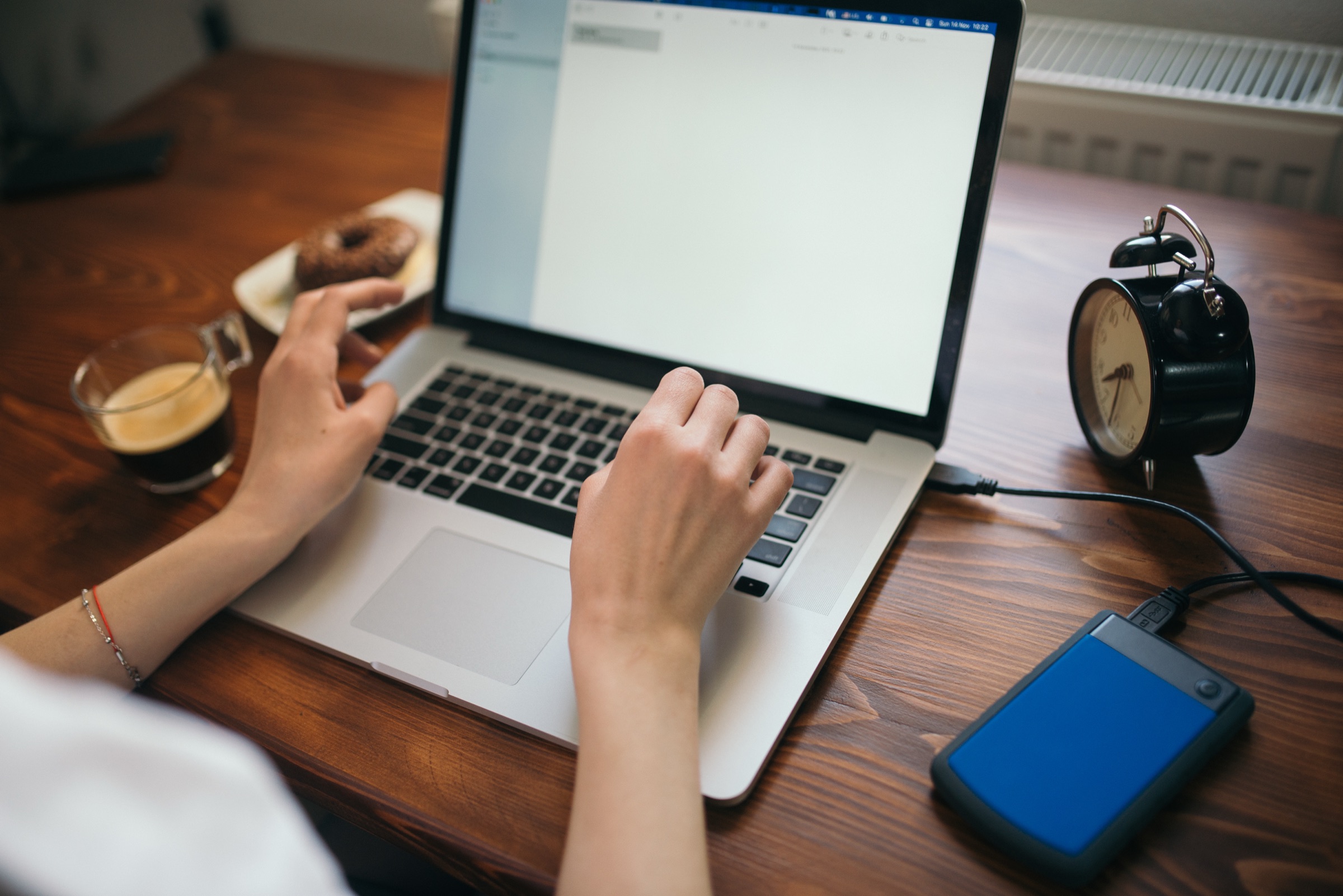
한 사람이 노트북을 조작하고 외장 저장장치가 케이블로 연결돼 있다. production sound 파일 복사나 checksum 완료를 증명하는 사진은 아니다.PHOTO: SHIXART1985 · CC BY 2.0 · DISPLAY CROP · SOURCE · CC BY 2.0
카드를 빨리 돌려줘야 했지만, 복사가 끝나기 전에 유일한 원본을 지울 수는 없었다.[U069]
복사가 끝났다는 표시만으로, 유일한 원본을 다시 써도 된다고 말할 수 있을까?
Beau Baker는 2005년 한 장기 TV 시리즈 현장에서 CF card·DVD-RAM·DAT "backup" tape를 함께 인계했다고 회고했다. DAT와 DVD-RAM이 사라진 이후 시기를 별도로 설명하며, CF card를 post house에 보내 복사한 뒤 돌려받아 재포맷·재사용했다고도 밝혔다.[U069] 두 시점은 같은 절차가 아니다.
MODERN EXPLANATORY RECONSTRUCTION · 오늘날 문서화된 지침은 요구된 복사와 검증이 끝날 때까지 매체 재사용을 보류한다. 담당자·사본 수·검증 방식·반환 조건은 제작마다 다르며, 이를 초기 전환기의 보편 관행으로 소급하지 않는다.[U272][U273]
검증 뒤에야 반환할 수 있었다
복사 진행률 100%는 사본이 온전히 도착했다는 확인과 같지 않다. Library of Congress는 checksum을 디지털 대상이 두 시점 사이 바뀌었는지 확인하는 방법으로 설명한다.[U268] 같은 절차로 계산한 checksum의 일치는 원본과 사본 사이의 byte-level integrity를 확인하는 근거다. 그러나 clipping·dropout·잘못된 트랙 배정은 별도의 내용 검수 대상이다. 이 정의가 production sound의 표준 관행이 된 시점은 이 출처만으로 확정할 수 없다.
파일 시대의 마지막 판단은 복사 완료가 아니라, 원본을 다시 써도 된다는 승인에 더 가까웠다.
EVIDENCE CONTEXT
이 페이지에서 사용한 근거
본문의 서사는 유지하고, 각 출처가 확인하는 내용과 한계를 먼저 보여 준다. English 원문과 출처는 펼쳐 확인할 수 있다.
U069
문맥 이해Beau Baker의 장기 TV series 회고는 2005년에 CF card·DVD-RAM·DAT backup tape를 함께 넘긴 구성과 이후 CF card를 post house에서 복사·반환·재사용한 시기를 구분해 기록한다. 한 mixer와 한 series의 장기 기억이므로 두 시점을 같은 2005년 절차로 합치거나 업계 전체의 전환 순서로 일반화할 수 없다.
원문·출처 보기
practitioner recollection
Is That Show Still On?
To begin this rambling saga, 2005: I had a HHB Portadat and a Sound Devices 744. I turned in the CF card and the DVD-RAM, plus the DAT ‘backup’ tape.
The digital tape recorded in a linear fashion, so transferring the audio was a ‘real time’ affair: a five-minute take took five minutes to transfer. The cassettes were fragile, and prone to mechanical failure after storage.
The CF cards were sent to the post house, copied, and returned to be reformatted and used again.
원문 열기IATSE Local 695 · publication date not stated
U268
문맥 이해Library of Congress glossary는 copy를 verifiably bit-identical한 digital content instance로, fixity를 두 시점 사이 object가 바뀌지 않았음을 나타내는 속성으로 정의한다. 현행 digital-preservation 용어이므로 초기 production sound에서 checksum이 표준화된 시점이나 원 녹음의 내용 품질을 확정하지 않는다.
원문·출처 보기
other
Digital Collections Management Glossary
Copies are verifiably bit-identical instantiations of digital content. As bit-identical items, copies have the same structure and related metadata. As such, derivative files or processed content are not copies of originals.
Fixity is a property of a digital object that indicates it has not changed between two points in time. Checksums (generally MD5, SHA1, or SHA256) are computed and compared with stored values in order to determine if the integrity of a digital object has been compromised.
문맥 이해Netflix의 현행 production guidance는 original camera·audio file copy에 checksum verification과 manifest를 요구하고 media 삭제·재사용의 최종 승인 담당을 두는 것이 바람직하다고 명시한다. 현재 특정 platform의 요구사항이므로 초기 file transition의 관행이나 모든 제작사의 보편 표준으로 소급할 수 없다.
원문·출처 보기
other
Production Assets: Data Management
All copies of original camera and audio files should include checksum verification, with either xxHash64be, xxHash128, or MD5 hash types.
During the checksum process, a unique machine-readable checksum manifest should be generated and accompany OCF and OPA files through all subsequent transfers, including final delivery.
Ideally, there is a designated party responsible for final approval to delete and recycle camera media.
문맥 이해FSU Film Handbook는 assistant editor가 audio SD card와 reports를 가져와 offload하고 ShotPut Pro의 safe-transfer verification 뒤에 card를 지우도록 지시한다. 교육기관의 현재 local workflow이므로 professional industry 전체의 역할 분담, 사본 수, 초기 file 시대의 erase 조건을 대표하지 않는다.
원문·출처 보기
manual
Offloading Media Cards
The Assistant Editor (AE) will retrieve the Red Mini Mag (containing the video), the SD card (containing the audio), and the camera reports from the ingest room cubby and bring them back to their assigned suite on the post hall for offloading.
The SD card will need to be erased after you have verification from ShotPut Pro that the data was transferred safely.
원문 열기FSU Film Handbook · current educational workflow
U069 · U268 · U272 · U273
03 · RECORDER ORIGIN · DEALER REQUEST051
051
RECORDER ORIGIN · DEALER REQUEST
믹서를 팔러 간 자리에서, 누가 녹음기를 요구했을까
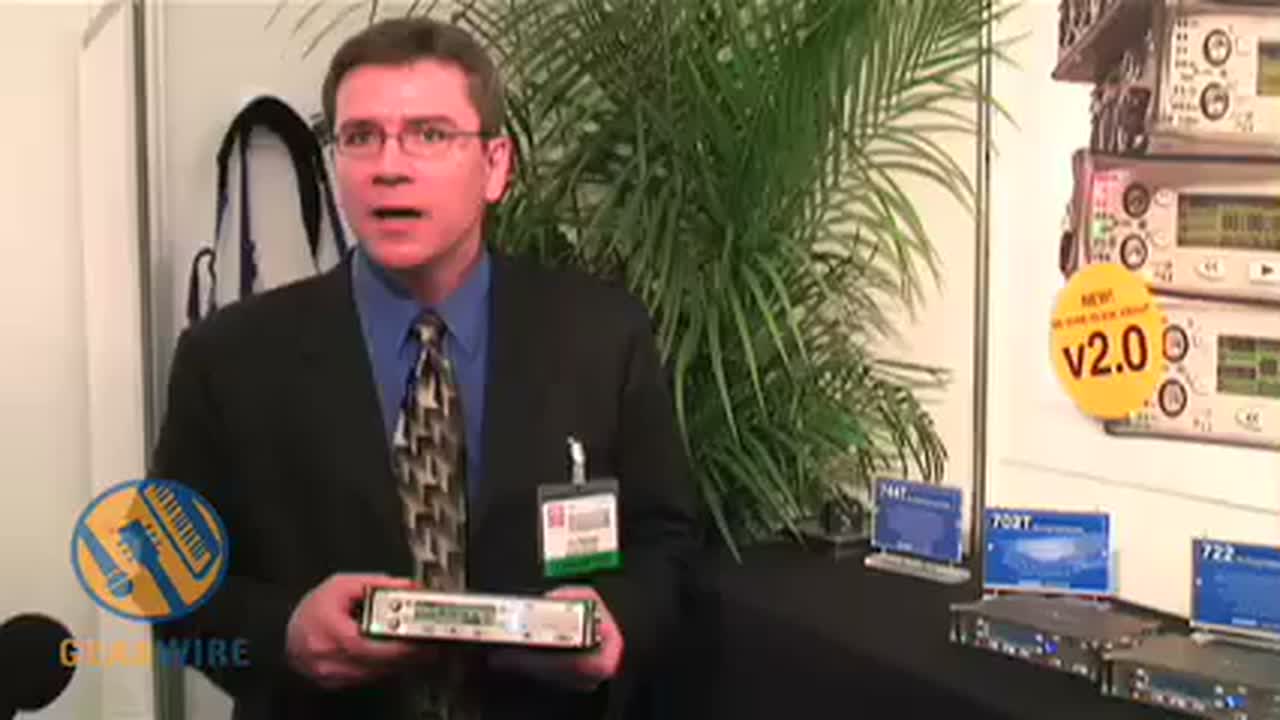
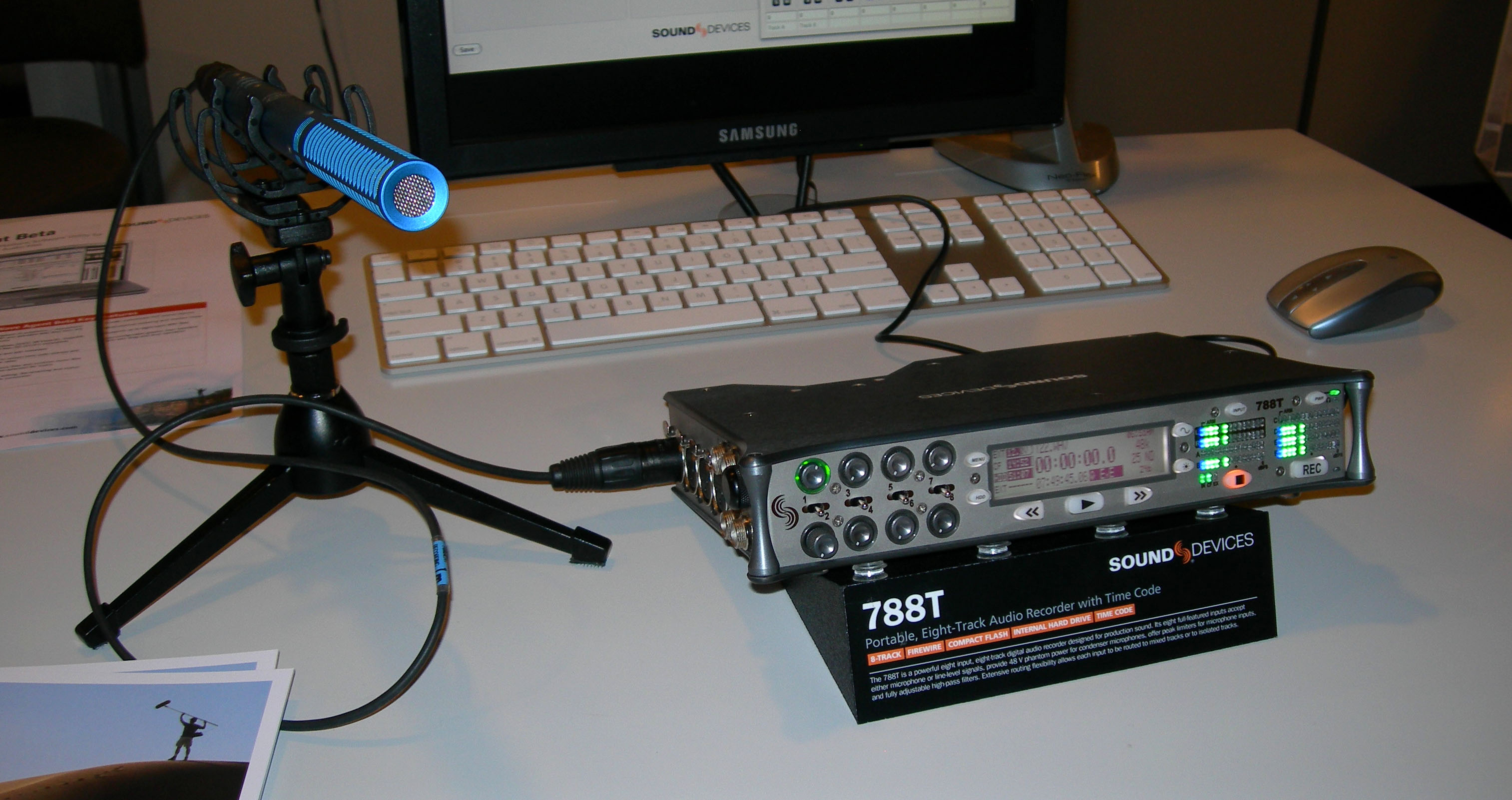
122nd AES 행사에서 Jim Koomar가 744T를 설명하는 Gearwire 영상 프레임. 2003년 NAB 또는 최초 시제품 공개 장면이 아니다.VIDEO FRAME: GEARWIRE · · DISPLAY CROP · SOURCE
설계자 Matt Anderson은 훗날 그 장비가 당시 별로 좋아 보이지 않았지만 공개됐다고 회고했다. NAB 2004에는 제품명과 사양이 붙은 722와 744T가 전시됐다.[2][3]
LATER DEMONSTRATION FRAME · 사진은 122nd AES 행사에서 Jim Koomar가 744T를 설명하는 Gearwire 영상 프레임이다. 2003년 NAB나 유럽 판매 출장 때 촬영된 장면이 아니다. 본문은 회사 후대 회고와 2004년 방문 기록을 구분해 구성했다.
휴대용 믹서를 찾던 사람들이 왜 같은 회사에 별도 녹음기까지 요구했을까?
요구가 돌아온 자리
당시 Sound Devices는 442 같은 휴대용 믹서로 알려진 회사였다. Jim Koomar와 Matt Anderson은 442를 팔기 위해 유럽을 돌았다. Anderson은 판매점과 고객이 하드디스크 녹음기를 요청했고, 귀국할 무렵 녹음기를 그리기 시작했다고 훗날 회고했다.[U046]
요구의 강도·도시·판매점 명단은 공개 자료에 없다. 그러나 믹서를 사던 사람들이 같은 회사에 별도 녹음기를 원했다는 흐름은 회고에서 확인된다.
선택은 하나였다
Sound Devices는 별도의 휴대용 파일 녹음기를 만들기로 했다. 작은 본체에 마이크를 바로 연결하고 소리를 파일로 남겨 컴퓨터로 넘길 수 있게 했다.[U046][3] 믹서를 없애는 장비가 아니라 그 옆에 놓일 별도 기록 장비였다.[U047]
2003년에는 첫 기계 시제품, 2004년에는 722·744T 전시가 이어졌다. 출하는 지역과 모델에 따라 엇갈렸다. 2004년 11월 영국 보도는 744T 출하와 722의 2005년 2월 예정만 확인한다.[5] 공개·전시·출하를 하나의 시점으로 합칠 수 없는 이유다.
믹서 회사가 받은 요구는 믹서를 더 크게 만드는 일이 아니었다. 현장에서 바로 파일을 남기는 별도 상자를 만드는 일이었다.
EVIDENCE CONTEXT
이 페이지에서 사용한 근거
본문의 서사는 유지하고, 각 출처가 확인하는 내용과 한계를 먼저 보여 준다. English 원문과 출처는 펼쳐 확인할 수 있다.
H051-01
문맥 이해Simon Elliott의 동시대 사용기는 2005년 DAT가 tape를 손상시킨 뒤 722를 구입하고 direct mic와 SQN mixer line-level 입력을 병행했으며 menu와 firmware 대응이 필요했다고 기록한다. 한 wildlife recordist의 722 경험이고 두 게재본은 같은 저자이므로 744T film·TV workflow나 제품군 전체의 reliability로 일반화할 수 없다.
원문·출처 보기
practitioner recollection
Sound Devices 722 Digital Audio Recorder
But in March 2005 my hand was forced when my portable DAT machine started to chew up tapes (to be honest I’ve never really liked DAT technology anyway).
If you buy either, I think it is fair to say that like a computer you are buying an unfinished product. They are subject to continuous development and improvement via downloaded firmware.
The user has access to a huge choice of setup parameters through the menu navigation, and this is not a recorder for the faint hearted, in that unless one only uses one set of mics or one recording set up, it is difficult to just plug in and start recording. A thorough knowledge of the menus and what they mean is essential.
In the field I acquired my 722 in April 2005, and at the time of writing have been able to use the unit for four months in a wide range of situations, from ice and snow to tropical rainforest, recording almost 1000 tracks. Recordings have been made directly into the mic inputs or at line level through an SQN mixer.
원문 열기Bioacoustics / Wildlife Sound · 2005; related expanded version 2006
U046
문맥 이해Matt Anderson의 회사 회고는 442 판매를 위한 유럽 출장에서 dealer와 customer가 hard-disk recorder를 요청했고 귀국 무렵 recorder를 구상했으며 초기 744T production과 firmware가 거칠었다고 기록한다. 후대 제조사 회고이므로 요청의 도시·규모·원인이나 초기 문제의 빈도와 전체 제품군의 상태는 확정할 수 없다.
원문·출처 보기
official retrospective
702, 702T, 722, 744T: The dawn of the SD recorder era – 2004
The origins of these recorders came from a European trip that Jim Koomar (Sales) and I took, selling the 442. Unexpectedly, everywhere we visited, dealers and customers begged us to make a hard-disk recorder. By the time we got back, I was starting to sketch out a recorder.
The first production runs of the 744T were really rough, and we had a hard time keeping up with the intense demand.
The first versions of firmware were also slightly less than stable, especially regarding the Firewire port operation.
원문 열기Sound Devices · retrospective publication date not stated; accessed 2026-09-29
U047
문맥 이해Neil Hillman의 동시대 review는 744T를 documentary에서는 442와 함께 메고 drama에서는 larger mixer의 output 뒤에 두는 두 운용으로 설명한다. 호평 성격의 단일 review이자 Yumpu mirror이므로 시장 보급률·표준 rig·장기 신뢰성을 확정하지 않는다.
원문·출처 보기
independent report
Sound Devices 744T
Sound Devices has delivered an amazingly compact yet feature-rich package with the SD744T, which by its introduction redefines our expectations for a multichannel digital location recorder; both in size and specification: either in a documentary, over-the-shoulder context, coupled to an equally-sized Sound Devices mixer, such as the 4-channel SD442; or on a drama recordist’s production-mixing trolley, sitting across the outputs of a larger, more comprehensive mixer.
문맥 이해TVTechnology에 재게재된 회사 회고는 722와 744T가 early 2005에 출하를 시작했다고 함께 정리한다. 2004년 UK 744T 출하 보도와 긴장하는 후대 단순화이므로 단일한 전 세계 출하일로 채택할 수 없다.
원문·출처 보기
official retrospective
Sound Devices Celebrates 15 Years
The 722 and 744T began shipping in early 2005.
원문 열기Sound Devices text reproduced by TVTechnology · 2013 retrospective; exact date not captured locally
[2]
문맥 이해Radio World의 동시대 보도는 전년도 design concept으로 보였던 744T가 NAB 2004에 다시 전시될 예정이었다고 기록한다. 전시 예고 기사이므로 2003 concept의 최종 모델명이나 2004 실제 출하일은 확정하지 않는다.
원문·출처 보기
independent report
Sound Devices Debuts Portable Audio Recorders
Sound Devices will show the 744T portable digital audio recorder, seen as a design concept at last year’s show, at NAB 2004.
원문 열기Radio World · 2004 NAB coverage; exact publication date not captured locally
[3]
문맥 이해NAB 2004 방문 기록은 722가 2-channel, 744T가 4-channel timecode recorder였고 현장 담당자가 release까지 약 60일이라고 말했다고 전한다. 방문자가 들은 forecast이므로 실제 release·출하 날짜나 지역별 availability를 증명하지 않는다.
원문·출처 보기
independent report
Digital Audio Field Recorders
The 722 is a 2-channel recorder, while the 744T is a 4-channel timecode recorder.
According to the reps I talked to at NAB, they are 60 days away from release.
문맥 이해동시대 업계 게재문은 744T를 digital·analog tape-based portable recorder의 replacement로 설계했고 FireWire로 computer에 file을 옮긴다고 소개한다. 제조사 발표 성격의 positioning 문구이므로 tape recorder의 실제 대체율이나 예정된 출하의 실현을 입증하지 않는다.
원문·출처 보기
other
Sound Devices 744T Nearing Release
Designed as a replacement for digital and analog tape-based portable recorders, the four-track 744T writes and plays audio files with bit depths of either 24 or 16 bit, with sample rates from 44.1 to 96 kHz, including pull-up sample rates, which can then be transferred to a computer via its FireWire port.
문맥 이해Sonic State는 2004년 11월 744T가 UK에서 출하 중이고 722의 UK availability는 2005년 2월로 예상된다고 보도했다. UK 지역 기사이므로 전 세계 첫 출하일이나 722의 실제 2005년 2월 출하를 확정할 수 없다.
원문·출처 보기
independent report
New Sound Devices HD Recorder Turns Heads
The Sound Devices 744T is currently shipping in the UK and for further information contact UK distributor Shure Distribution UK on 020 8808 2222 or info@shuredistribution.co.uk
UK availability of the 722 is expected in February 2005.
03 · RECORDER IN THE FIELD · NEW RESPONSIBILITY052
052
RECORDER IN THE FIELD · NEW RESPONSIBILITY
상자가 작아지자, 사람은 무엇을 더 봐야 했을까
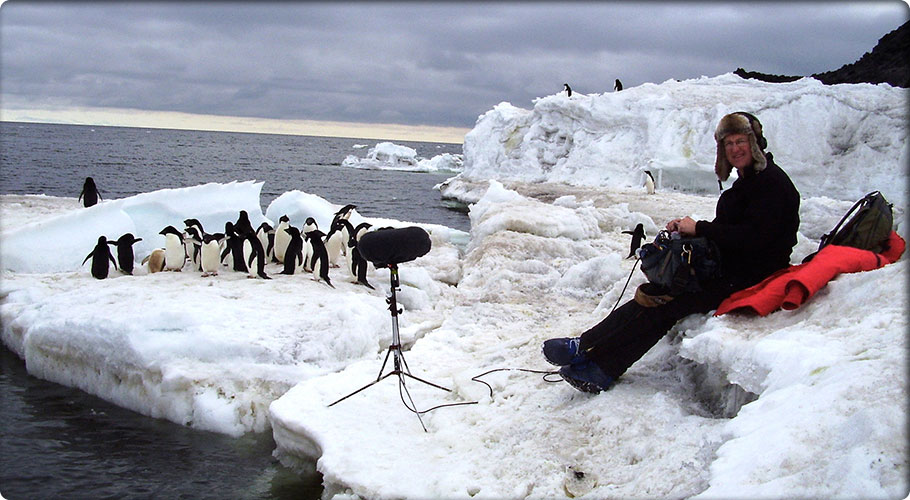
Chris Watson이 빙상 위에서 헤드폰과 가방형 장비를 운용한다. Sound Devices의 후대 사례 페이지는 Frozen Planet 작업에서 744T와 MixPre를 사용했다고 설명한다. 2004년 출시 현장의 사진은 아니다.SOURCE: SOUND DEVICES · · DISPLAY CROP · SOURCE
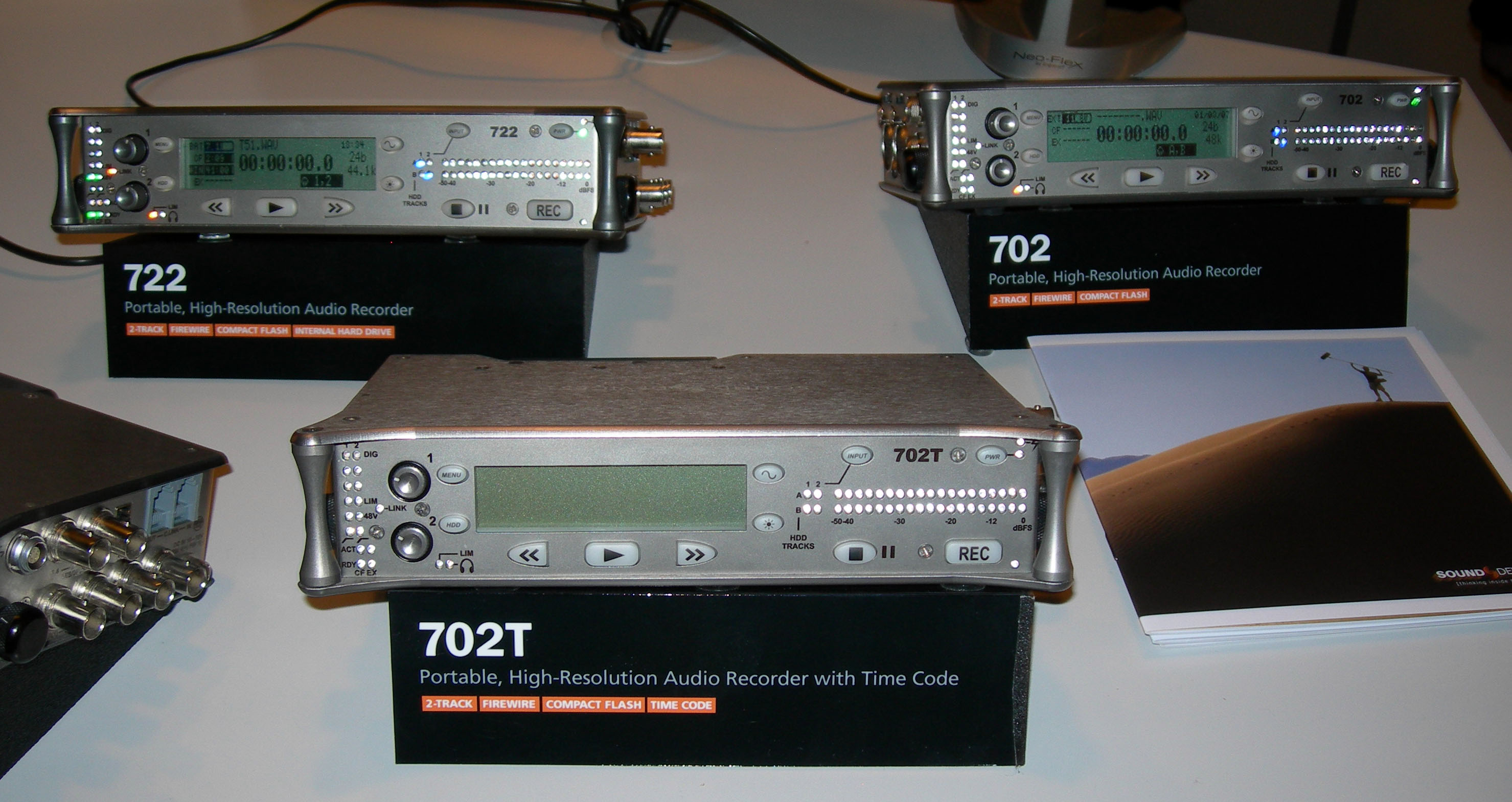
2008년 IBC 전시대의 722·702·702T. 702·702T가 후속으로 계열에 추가된 모습이며 2004년 최초 공개 모델 전체를 뜻하지 않는다.PHOTO: CLI · WIKIMEDIA COMMONS · CC BY-SA 4.0 · DISPLAY CROP · DISPLAY CROP · SOURCE · CC BY-SA 4.0
2005년 봄, Simon Elliott는 여전히 DAT를 쓰고 있었다.
3월에 휴대용 DAT가 테이프를 씹기 시작하자 그는 그해 봄 722를 샀다고 적었다.[H051-01]
ATTRIBUTED EXPERIENCE · Elliott 한 사람의 동시대 실사용 기록이다. 메인 사진은 Chris Watson의 후대 Frozen Planet 작업 장면으로, 2005년 Elliott나 2004년 출시 현장을 보여 주지 않는다.
상자가 작아지자, 한 사람의 눈은 무엇을 더 확인해야 했을까?
두 번째 확인 화면
Elliott는 722를 마이크에 바로 연결하기도 하고 SQN 믹서의 선 출력으로 받기도 했다.[H051-01] 2005년 《Resolution》은 744T와 442를 나란히 건 다큐멘터리 구성과 더 큰 믹서의 출력을 받는 드라마 현장 구성을 설명했다.[U047]
두 기기는 같은 일을 하지 않았다. 믹서는 지금 들을 소리를 만드는 자리였고, 녹음기는 나중에 다시 열 수 있는 파일을 남기는 자리였다. 왼손이 페이더를 움직이는 동안 눈은 녹음기의 REC 표시를 찾았다. 두 확인이 한 사람의 몸 위에서 함께 돌아갔다.
EDITORIAL INTERPRETATION · 이 작업 변화는 U047·H051-01·H051-02를 바탕으로 한 해석이며 모든 현장이 같은 구성이었다는 뜻은 아니다.
작아진 것과 남은 것
처음부터 매끄럽지는 않았다. Anderson은 초기 744T 생산분과 첫 펌웨어가 거칠었다고 회고했다.[U046] Elliott는 722와 744T가 내려받는 펌웨어로 계속 개선되는 제품이라고 평가하면서 메뉴를 제대로 알아야 한다고 썼다.[H051-01]
7-Series는 사람을 기록에서 빼내지 않았다. 믹서의 순간 판단 옆에 녹음 상태를 확인할 화면을 하나 더 놓았다.
EVIDENCE CONTEXT
이 페이지에서 사용한 근거
본문의 서사는 유지하고, 각 출처가 확인하는 내용과 한계를 먼저 보여 준다. English 원문과 출처는 펼쳐 확인할 수 있다.
A051-01A
문맥 이해Zaxcom의 후대 연혁은 1996년에 Glenn Sanders와 Howard Stark가 Deva를 설계·개발·제조했다고 기록하며 이를 first 4-channel portable hard disk recorder라고 부른다. 제조사의 최초성 주장이고 전 세계 선행 제품을 배제하는 독립 조사 자료가 아니므로 절대적 최초로 확정하지 않는다.
원문·출처 보기
official retrospective
History
**1996:** Glenn Sanders, President and Howard Stark, Chief Engineer, design, develop, and manufacture the Deva, the first 4-channel portable hard disk recorder, changing the landscape of location sound recording.
원문 열기Zaxcom · publication date not stated; accessed 2026-09-29
A051-01B
문맥 이해Mix의 1999년 review는 compact 4-channel disk recorder인 Deva가 1996 AES에서 처음 공개됐고 timecode·DC power·lightweight 특성을 갖췄다고 기록한다. 공개 시점과 사양을 확인하는 단일 review이므로 최초 고객 출하일이나 세계 최초 지위를 확정하지 않는다.
원문·출처 보기
independent report
Zaxcom Audio Deva: PORTABLE DIGITAL RECORDER/MIXER
However, another solution was on the horizon: The Zaxcom Audio Deva (pronounced like “diva”), a compact, 4-channel disk recorder, was first unveiled at AES in 1996. Timecode-capable, DC-powered and lightweight, Deva seemed ideally suited for location audio and offered 20-bit uncompressed recording/playback.
문맥 이해Nagra의 공식 archive는 Nagra V가 2002~2006년에 제조됐고 on-the-shoulder·on-location 요구를 위한 2-channel recorder로 removable 2.5-inch hard disk 또는 CompactFlash를 사용했다고 설명한다. 현행 보존 page이므로 정확한 발표·첫 출하일이나 당시 판매량은 확정하지 않는다.
원문·출처 보기
other
Nagra V official product archive
Manufactured from 2002 to 2006
2 channels (24 bit, 96 kHz AD / DA)
The Nagra V is a light, compact and reliable recorder manufactured to suit on-the-shoulder / on-location engineer needs.
The Nagra V records to a removable 2.5″ hard disk OR compact Flash card allowing approximately 1 hour of 48 kHz 24-bit recording per GB of available disk / card space.
문맥 이해4RFV의 발표 기사는 PortaDrive를 8-track location recorder로 소개하며 removable 2.5-inch hard drive와 six-into-two digital mixer를 설명하고 AES West Coast debut를 기록한다. 제조사 발표성 기사이고 later in the year라는 shipping 문구는 예정이므로 실제 출하일로 확정하지 않는다.
원문·출처 보기
other
HHB launch new Portadrive At AES
With 8 tracks of pristine 24-bit/96kHz recording, flexible on-board mixing and comprehensive timecode facilities, the new HHB Portadrive is set to be the new standard in location sound recording.
Continuing a fine heritage of innovative HHB portable recorders, that have consistently led the way in meeting audio demands within the video market, the Portadrive records audio onto a compact, robust, shock resistant removable 2.5" hard drive in industry standard BWF or SDII formats.
A comprehensively equipped six into two digital mixer is built-in, enabling the simultaneous recording of a stereo mix alongside 6 discrete inputs.
문맥 이해Radio World의 2003년 product listing은 PortaDrive를 location sound recorder로 분류하고 removable 2.5-inch hard drive, eight-track recording, built-in six-into-two digital mixer를 설명한다. 짧은 제품 소개이므로 최초 출하일·실사용 성과·시장 보급률은 제공하지 않는다.
원문·출처 보기
independent report
New Products (Aug 2003) — HHB Portadrive
This portable recorder uses a compact, robust, shock-resistant removable 2.5″ hard drive to save files in BWF and SDII formats, allowing full compatibility with Mac and PC-based digital audio workstations, connecting via a drive docking station. More than two hours of eight-track 24-bit/96kHz recording, or more than nine hours of four-track 24-bit/48kHz are possible on the supplied hard drive. A comprehensive six into two digital mixer is built-in, enabling the simultaneous recording of a stereo mix alongside six discrete inputs.
문맥 이해HHB manual은 PortaDrive를 portable 8-channel hard disk recorder로 규정하고 세 개의 6-into-2 digital mixer와 removable 40GB HD를 문서화한다. 2004년 manual 사양은 정확한 첫 발표·출하일이나 현장 채택률을 증명하지 않는다.
원문·출처 보기
manual
PortaDrive Operations Manual v1.01
Rugged, all in one, portable 8-channel hard disk (HD) audio recorder
3 comprehensively equipped 6-into-2 digital mixers built-in
문맥 이해Richard Lightstone의 후대 회고는 fully functional Cantar-X가 2003년에 나왔고 그해 NAB에서 시연되는 것을 보았다고 기록한다. 회고의 released 표현만으로 정확한 양산 완료·최초 고객 출하일을 확정하지 않는다.
원문·출처 보기
practitioner recollection
Cantar-X3
In 2003, the fully functional Cantar-X was released and I still remember the excitement of seeing it demonstrated at NAB that year.
원문 열기IATSE Local 695 · publication date not stated; retrospective
A051-04B
문맥 이해Mix의 실기 review는 Cantar-X가 2.5-inch internal HD와 optical media에 동시 기록하고 여섯 track과 2-track stereo mix로 routing할 수 있다고 설명한다. 한 reviewer의 시험이므로 모든 configuration의 안정성·채택률이나 최초 출하일을 확정하지 않는다.
원문·출처 보기
independent report
Aaton Cantar-X Field Recorder With Mixer
The Cantar-X field recorder, designed by French film camera maker Aaton, covers almost every conceivable requirement for video and film, with multichannel 24/96, simultaneous recording to a 2.5-inch internal HD and CD-R/DVD+R/DVD-RAM (internal or external) in a slick, ergonomic package.
All mic and line inputs can be routed and panned to any of the six tracks (plus a 2-track stereo mix), with playback monitoring being its own subset of presets.
문맥 이해Mix의 2002년 소개는 초기 PD-6 상단에 double-sided mini DVD-RAM drive가 있었다고 설명한다. 공개 전 소개 기사이므로 예정된 initial delivery나 실제 출하를 확정하지 않으며 초기형을 HDD recorder로 소급할 수 없다.
원문·출처 보기
independent report
TECHNOLOGY SPOTLIGHT: Fostex PD-6
Under a top panel door lies the drive for double-sided, mini DVD-RAM discs — about twice the cost of a DAT tape, but offering far greater storage capacity, instant access and compatibility with DVD drives on the host PC.
문맥 이해DC Audiovisuel은 2004년 3월 15일 PD-6 internal hard disk drive가 공식 발표됐고 model 9056이 Toshiba 40GB 1.8-inch drive라고 기록한다. 발표 기사이므로 실제 공급·장착 시작일이나 모든 PD-6의 기본 구성까지 확정하지 않는다.
원문·출처 보기
other
Fostex PD6 about to upgrade
This piece of news was expected for a year and has been, officially, announced on March 15, 2004.
The PD6 internal drive (model 9056) is a Toshiba 40GB 1.8” hard drive, partitioned into twenty-six 1.46GB areas, which provides the equivalent of as many “mini” 8 cm DVD-RAM sides.
문맥 이해Sonicstate의 2004년 발표 보도는 R-4가 internal 40GB hard drive에 기록하는 4-channel portable digital recorder이고 2005년 2월 shipping 예정이라고 전한다. 예정 문구이므로 2004년 실출하나 2005년 2월 실제 출하를 입증하지 않는다.
원문·출처 보기
independent report
AES: Edirol’s New 4 Channel Portable Digital Recorder
The R-4 is a 4 channel portable digital recorder and wave editor - all in one convenient unit.
The R-4 records directly to an internal 40GB hard drive providing storage capacity for 58 hours of 16-bit/44.1kHz stereo recording or over 17 hours at 24-bit/96kHz.
문맥 이해Macworld는 2005년 3월 R-4가 전년 10월 처음 소개된 뒤 현재 출하 중이며 40GB hard drive를 탑재했다고 보도했다. 당시 출하 상태는 확인하지만 최초 고객 출하일·지역별 availability·판매량은 제공하지 않는다.
원문·출처 보기
independent report
Edirol ships R-4 recorder with BWF format support
which was first introduced last October, is now shipping.
The R-4 features a 40GB hard drive and USB 2.0 connectivity, with the ability to hold up to 17 hours of material at 24-bit/96kHz quality or up to 58 hours at 16-bit/44.1kHz, which is comparable to a CD.
문맥 이해Simon Elliott의 동시대 사용기는 2005년 DAT가 tape를 손상시킨 뒤 722를 구입하고 direct mic와 SQN mixer line-level 입력을 병행했으며 menu와 firmware 대응이 필요했다고 기록한다. 한 wildlife recordist의 722 경험이고 두 게재본은 같은 저자이므로 744T film·TV workflow나 제품군 전체의 reliability로 일반화할 수 없다.
원문·출처 보기
practitioner recollection
Sound Devices 722 Digital Audio Recorder
But in March 2005 my hand was forced when my portable DAT machine started to chew up tapes (to be honest I’ve never really liked DAT technology anyway).
If you buy either, I think it is fair to say that like a computer you are buying an unfinished product. They are subject to continuous development and improvement via downloaded firmware.
The user has access to a huge choice of setup parameters through the menu navigation, and this is not a recorder for the faint hearted, in that unless one only uses one set of mics or one recording set up, it is difficult to just plug in and start recording. A thorough knowledge of the menus and what they mean is essential.
In the field I acquired my 722 in April 2005, and at the time of writing have been able to use the unit for four months in a wide range of situations, from ice and snow to tropical rainforest, recording almost 1000 tracks. Recordings have been made directly into the mic inputs or at line level through an SQN mixer.
원문 열기Bioacoustics / Wildlife Sound · 2005; related expanded version 2006
H051-02
문맥 이해공식 guide는 744T가 standalone recorder로 동작하면서 442·302 같은 outboard audio mixer와 함께 사용할 때 강점을 갖는다고 설명한다. 후기 rev.2.67 문서이므로 2004~2005 최초 firmware 상태나 실제 채택률·역할 분담을 입증하지 않는다.
원문·출처 보기
manual
744T User Guide and Technical Information
While the 744T is a very capable recorder by itself, it truly excels when used in conjunction with an outboard audio mixer such as Sound Devices’ own 442 or 302.
원문 열기Sound Devices · firmware rev. 2.67; publication date not stated
U046
문맥 이해Matt Anderson의 회사 회고는 442 판매를 위한 유럽 출장에서 dealer와 customer가 hard-disk recorder를 요청했고 귀국 무렵 recorder를 구상했으며 초기 744T production과 firmware가 거칠었다고 기록한다. 후대 제조사 회고이므로 요청의 도시·규모·원인이나 초기 문제의 빈도와 전체 제품군의 상태는 확정할 수 없다.
원문·출처 보기
official retrospective
702, 702T, 722, 744T: The dawn of the SD recorder era – 2004
The origins of these recorders came from a European trip that Jim Koomar (Sales) and I took, selling the 442. Unexpectedly, everywhere we visited, dealers and customers begged us to make a hard-disk recorder. By the time we got back, I was starting to sketch out a recorder.
The first production runs of the 744T were really rough, and we had a hard time keeping up with the intense demand.
The first versions of firmware were also slightly less than stable, especially regarding the Firewire port operation.
원문 열기Sound Devices · retrospective publication date not stated; accessed 2026-09-29
U047
문맥 이해Neil Hillman의 동시대 review는 744T를 documentary에서는 442와 함께 메고 drama에서는 larger mixer의 output 뒤에 두는 두 운용으로 설명한다. 호평 성격의 단일 review이자 Yumpu mirror이므로 시장 보급률·표준 rig·장기 신뢰성을 확정하지 않는다.
원문·출처 보기
independent report
Sound Devices 744T
Sound Devices has delivered an amazingly compact yet feature-rich package with the SD744T, which by its introduction redefines our expectations for a multichannel digital location recorder; both in size and specification: either in a documentary, over-the-shoulder context, coupled to an equally-sized Sound Devices mixer, such as the 4-channel SD442; or on a drama recordist’s production-mixing trolley, sitting across the outputs of a larger, more comprehensive mixer.
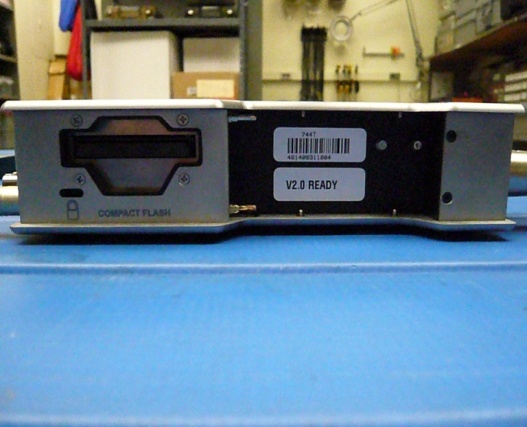
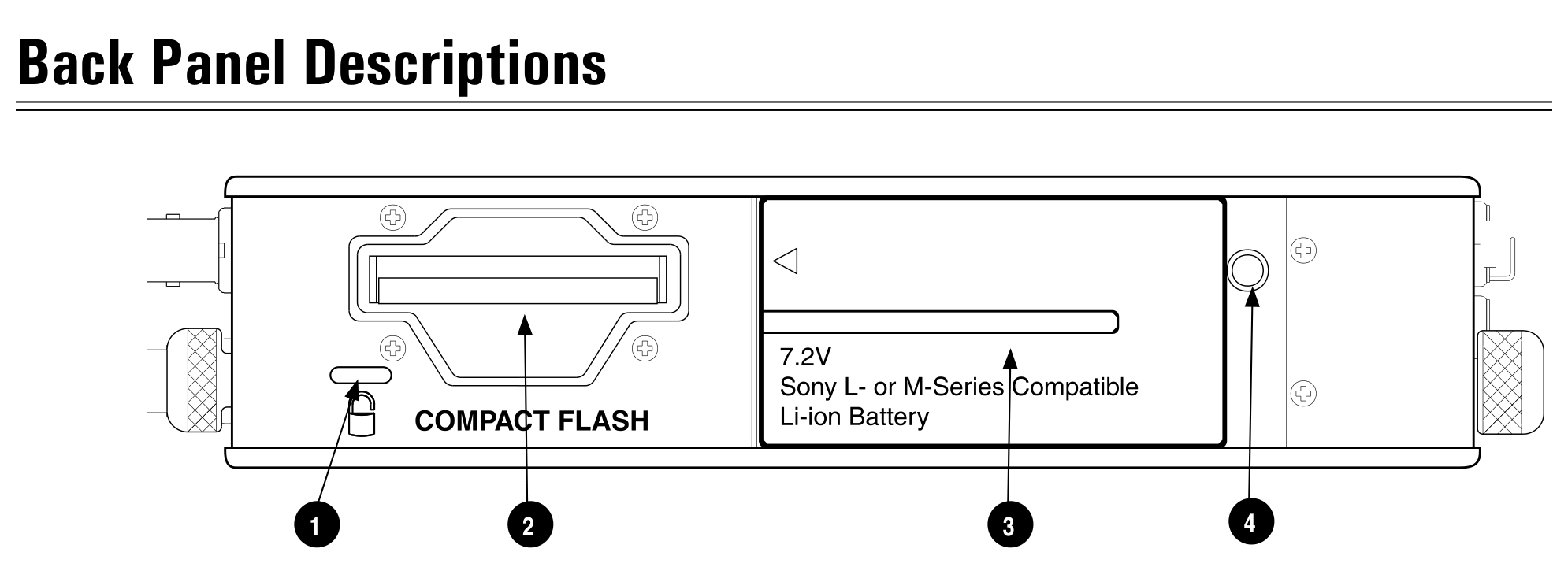
미국 교통부·FAA의 2020년 측정 보고서에 수록된 744T 후면 사진. 왼쪽에 CompactFlash 슬롯이 보인다. 2000년대 중반 촬영 현장이나 기록 중인 상태를 보여 주는 사진은 아니다.PHOTO: USDOT VOLPE / FAA REPORT FIG.23 · PHOTOGRAPHER NOT STATED · DISPLAY CROP · SOURCE
2000년대 중반, 이동 촬영을 앞둔 현장 녹음 담당자가 744T의 매체 상태를 다시 본다.
곧 계단을 오르고 차량에 타야 한다. 그는 남은 용량만 보지 않는다. 장비가 얼마나 흔들릴지도 함께 본다. 녹음을 시작한 뒤에도 시선은 소리의 크기와 매체 표시를 지난다.
EDITORIAL RECONSTRUCTION · 후기 744T 매뉴얼과 2005년 동시대 리뷰를 조합한 설명용 장면이다. 특정 작품의 실황이나 2004년 첫 출하 기기 전체의 상태가 아니다.[H053-01][H053-02]
사람이 뛰고 차량이 흔들릴 때, 소리는 어느 매체에 남아야 했을까?
같은 가방 안의 다른 약점
744T의 내부 HDD는 주 저장공간이었다. 그러나 반복해서 꺼내 후반에 넘기도록 만든 교환 매체는 아니었다. 매뉴얼은 극심한 움직임이 예상되는 용도에서는 CF에만 기록하라고 권한다.[H053-01]
CF는 탈착할 수 있고 기계식 HDD보다 충격에 강했다. 744T는 CF를 단독으로 쓰거나 내부 HDD와 동시에 쓸 수 있었다.[H053-01] Neil Hillman은 2005년 리뷰에서 이 동시 기록을 안전 여유로 평가했지만, 이는 모든 실패를 막는다는 보증이 아니다.[H053-02]
이동 강도에 따라 기록 대상을 골랐다
카트에 세워 둔 장비로 오래 녹음할 때와 가방을 멘 채 이동할 때의 조건은 달랐다. 현장 녹음 담당자는 이동 강도를 보고 HDD와 CF 가운데 기록 대상을 정하거나 두 매체를 함께 썼다.
편집 해석: 두 매체에 함께 쓰면 한쪽 매체에 문제가 생겼을 때 다른 기록을 확인할 여지가 생긴다. 다만 두 기록은 같은 녹음기와 전원·입력을 공유하므로 기기 전체의 사고까지 독립해 막지는 못한다.
CF도 사용 표시가 켜진 동안 빼면 현재 파일이 손상되고 FAT까지 손상될 수 있었다. 카드의 쓰기 속도도 사용 전에 확인해야 했다.[H053-01]
사람은 남은 용량과 이동 중 충격을 따로 보고 기록 대상을 정할 수 있었다.
EVIDENCE CONTEXT
이 페이지에서 사용한 근거
본문의 서사는 유지하고, 각 출처가 확인하는 내용과 한계를 먼저 보여 준다. English 원문과 출처는 펼쳐 확인할 수 있다.
H053-01
문맥 이해공식 guide는 internal HDD를 주 저장공간이자 비인계 매체로 규정하고 extreme motion에서는 CF-only를 권하며 CF가 단독 또는 HDD와 동시 기록될 수 있다고 문서화한다. 후기 rev.2.67 문서이므로 2004년 초기 hardware·firmware 상태나 동시 기록이 모든 failure를 막는다고 입증하지 않는다.
원문·출처 보기
manual
744T User Guide and Technical Information
The 744T’s internal hard disk drive is the 744T’s primary storage medium.
The internal hard drive is not intended to be a swappable, deliverable medium.
If the recorder is used in applications subject to extreme motion, Sound Devices recommends recording to CompactFlash only.
The 744T can write to and read from CF cards as either its sole storage medium or simultaneously with the internal hard drive.
If the CF is removed while the LED is lit, at the very least the file will be corrupted and there is a possibility of FAT corruption as well.
원문 열기Sound Devices · firmware rev. 2.67; publication date not stated
H053-02
문맥 이해Neil Hillman의 동시대 review는 internal disk와 CompactFlash에 동시에 쓰는 기능을 reassuring한 안전 여유로 평가했다. 단일 reviewer의 비유적 평가이므로 독립 backup·무손실·모든 failure 방지를 뜻하지 않는다.
원문·출처 보기
independent report
Sound Devices 744T
Usefully, the ability to write to an external Compact Flash card — simultaneously while writing to the internal disk if required — adds a reassuring ‘belt’ to its figurative pair of ‘braces’.
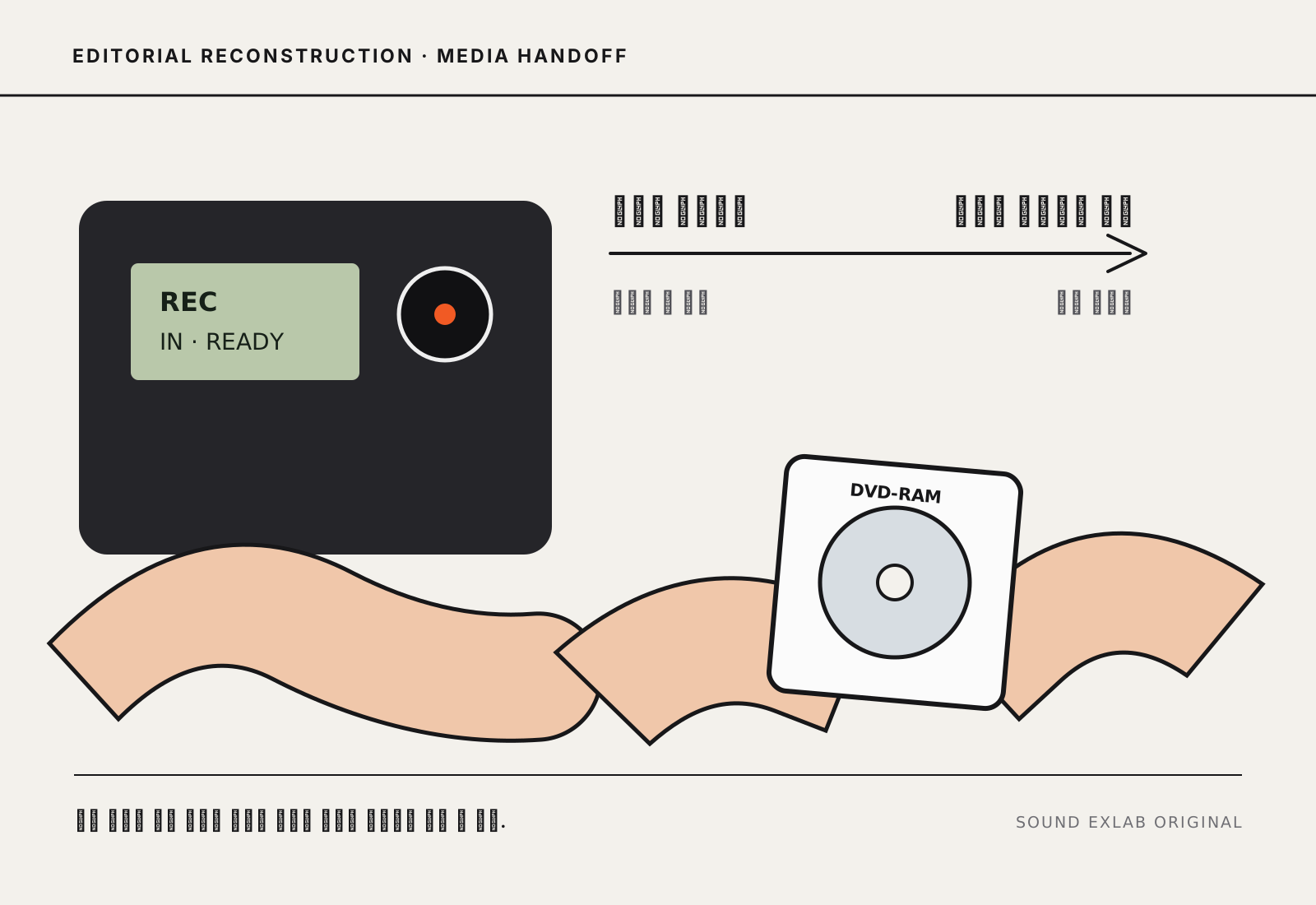
SOUND EXLAB 설명용 재구성. 녹음기 쪽 기록으로 다음 촬영을 이어 가는 동안 별도의 인계 매체가 후반으로 이동하는 작업을 보여 준다. Bartek의 실제 장비나 문제 매체를 복원한 장면은 아니다.SOUND EXLAB · ORIGINAL EDITORIAL RECONSTRUCTION ·
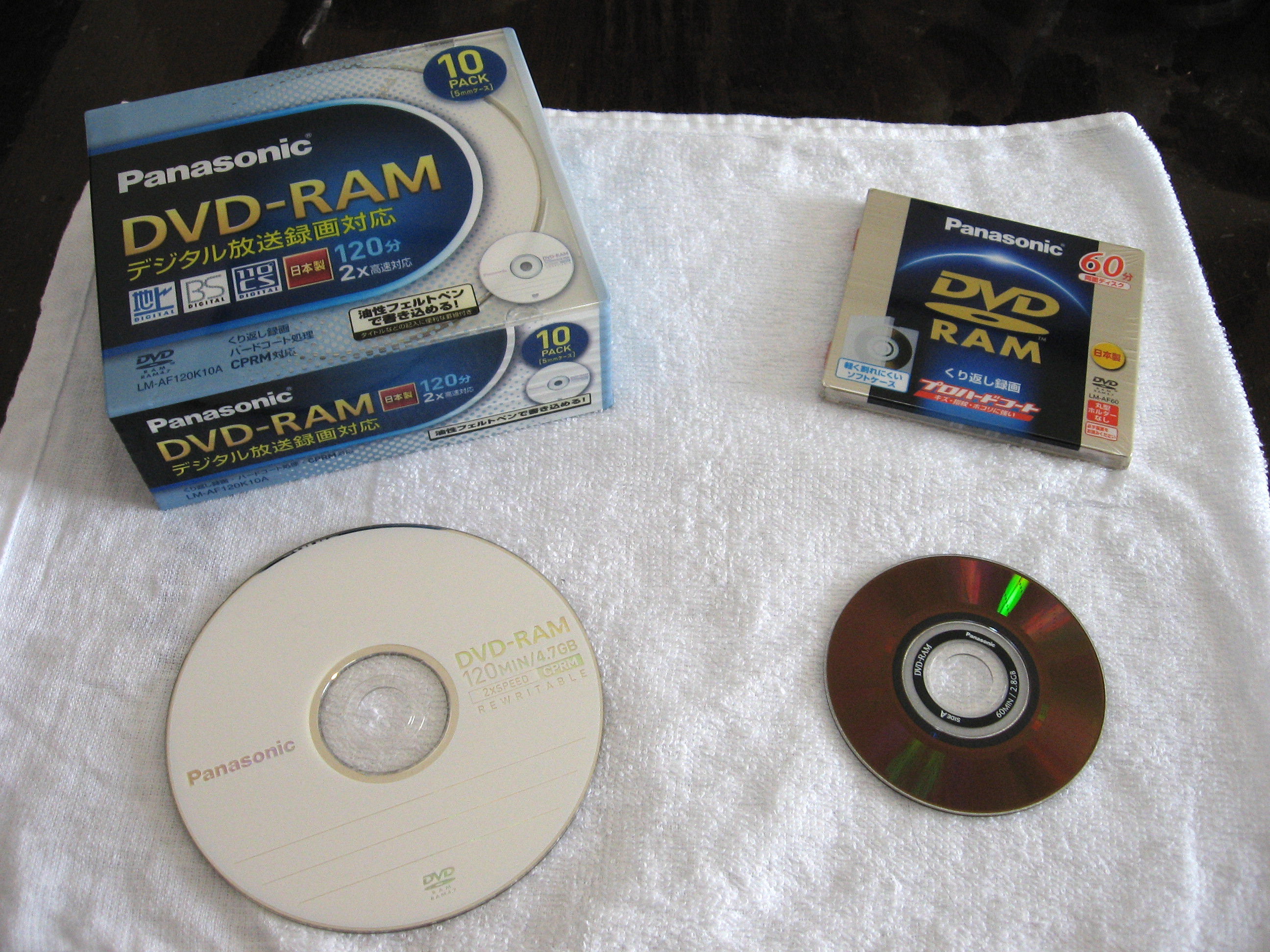
12cm와 8cm Panasonic DVD-RAM. 744T에서 DVD-RAM을 쓰려면 본체 밖의 지원되는 FireWire drive가 필요했다. 사진은 매체의 물성만 보여 준다.PHOTO: 阪神強いなプラス · BRIGHTNESS: UBCULE · NO FURTHER CHANGES · DISPLAY CROP · SOURCE · CC BY-SA 3.0
2007년 4월, JWSOUND 사용자 Bartek은 필름 롤이 바뀔 때마다 외장 장치로 DVD-RAM을 만들고 기록 목록과 대조한 뒤 배송을 위해 넘겼다.[H054-01]
며칠에 한 번씩 후반에서 연락이 왔다. “기록 목록이 없다”, “7F-3이 없다”는 내용이었다. Bartek은 자신의 744와 백업 저장장치에 해당 파일이 있는지 확인했다. 누락된 테이크는 새 매체에 모아 기록 사본과 함께 다시 보냈다.[H054-01]
ATTRIBUTED USER EXPERIENCE · 공개 게시판 사용자 한 명의 자기보고다. 실명·작품명·지역과 누락 원인은 확인되지 않았다. 사진 속 DVD-RAM은 당시 문제 매체나 744T용 공식 매체가 아니다.
후반에 파일을 보내고도 촬영을 계속하려면, 무엇을 녹음기 쪽에 남겨야 했을까?
녹음기 쪽 기록과 인계 매체를 나눴다
744T의 내부 HDD는 기기 안의 주 저장공간이며 반복해서 뽑아 건네는 교환 매체가 아니었다.[H054-03] 별도의 외장 장치에서 만든 DVD-RAM은 배송을 위해 넘길 수 있었다.[H054-01][H054-03]
DVD-RAM은 744T에 내장된 장치가 아니었다. 지원되는 외장 장치를 연결해야 DVD-RAM에 기록할 수 있었다.[H054-03]
누락된 테이크를 다시 보냈다
후반에서 7F-3이 보이지 않았을 때, Bartek의 744와 백업 저장장치에 있던 파일은 누락된 테이크의 인계본을 다시 만드는 근거가 됐다. 다만 누락이 어디서 생겼는지는 끝내 확인되지 않았다. 이를 744T나 DVD-RAM의 일반적 고장으로 확대할 수 없다.[H054-01]
여러 매체의 가치는 인계 뒤에도 다시 확인할 기록을 남길 수 있다는 데 있었다.
다음 문제는 파일 안에서 장면과 테이크를 식별하는 일이었다.
EVIDENCE CONTEXT
이 페이지에서 사용한 근거
본문의 서사는 유지하고, 각 출처가 확인하는 내용과 한계를 먼저 보여 준다. English 원문과 출처는 펼쳐 확인할 수 있다.
H054-01
문맥 이해JWSOUND의 단일 사용자 보고는 post가 찾지 못한 file이 recorder와 backup에는 남아 있었다는 사례를 제공한다. 실명·작품·지역이 확인되지 않았고 누락 원인도 판명되지 않아 744T나 DVD-RAM의 일반 고장으로 확대할 수 없다.
원문·출처 보기
practitioner recollection
One troubled shoot
I'm using the 744T v2.10. At film break I burn a DVD RAM verify the content Vs the logs I hand it over for shipping.
Every other day I get a message from post "Logs missing" or scene 7F-3 missing, etc.
I of course have a carbon copy of the logs, and have been able to confirm that the "missing files" do infact exist on my 744 as well as on the backup drives.
So I burn a Missing takes roll redo a copy of the logs and off we go.
I do a firewire transfer from the 744 to the SD burner
원문 열기JWSOUND · thread started 2007-04-11; last update 2007-04-15
H054-02
문맥 이해Sound Devices의 technical note는 2.0 firmware 설치 가능 여부와 external FireWire drive support를 구분하고 후자에는 2.0-ready hardware가 필요했다고 밝힌다. 게시일·factory update 수량·serial range가 없어 정확한 적용 시점과 보급 범위는 확정하지 않는다.
원문·출처 보기
other
Firmware Updates for Pre-2.0 Hardware
All 7-Series recorders, whether they have been updated to be "2.0-ready" or not can run 2.0 firmware update.
The only feature that requires 2.0-ready hardware is external FireWire drive support.
If the unit has not been updated, there is no option to record or transfer files to attached, external FireWire drives.
원문 열기Sound Devices · last-updated value not exposed; accessed 2026-09-30
H054-03
문맥 이해rev.2.10 manual은 internal HDD가 주 저장공간이자 비인계 매체이고 2.0-ready unit만 external FireWire drive를 storage로 쓸 수 있으며 DVD-RAM은 attached volume이라고 설명한다. 제3자 mirror의 전환기 manual이므로 Bartek의 burner 구성·누락 원인이나 모든 744T의 hardware 상태를 추정할 수 없다.
원문·출처 보기
manual
744T User Guide and Technical Information
The 744T’s internal hard disk drive is the 744T’s primary storage medium.
The internal hard drive is not intended as a swappable exchange medium.
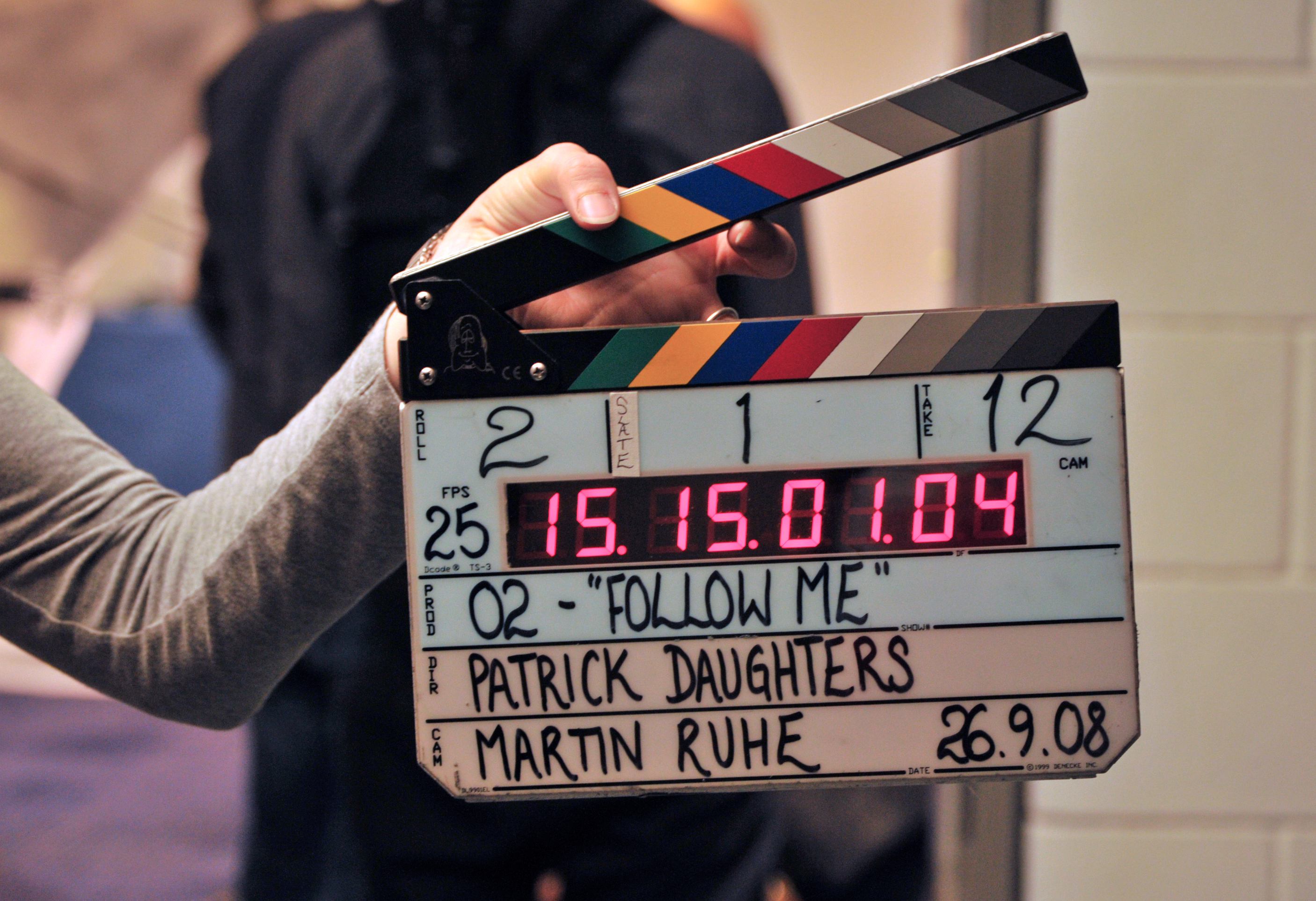
2008년 O2 촬영에서 두 사람이 디지털 슬레이트를 들고 있다. timecode와 scene·take 기입 칸이 보이지만, 표시값이 recorder의 BWF metadata와 일치하거나 동기화가 검증됐다는 뜻은 아니다.PHOTO: MATTBR · CC BY 2.0 · DISPLAY CROP · SOURCE · CC BY 2.0
2010년 무렵, 촬영 직전 cart 옆이다.
“32A가 아니라 32B입니다.”
slate 표기가 바뀌었다. recorder는 scene의 뜻을 스스로 고쳐 주지 않는다. 현장 녹음 담당자는 화면의 scene·take와 timecode를 다시 본다. 방금 들은 호출과 다음 파일이 같은 촬영을 가리키는지 확인한 뒤 REC를 준비한다.
EDITORIAL RECONSTRUCTION · 여러 공식 기능과 동시대 workflow 기록을 조합한 설명용 재구성이다. 특정 작품·인물의 실황이 아니며, utility가 입력을 전담했다고 가정하지 않는다.[H055-03]
파일은 무엇을 기억해야 했나
파일 녹음은 테이프의 선형 기록·재생에서 파일 단위 접근으로 옮겨 갔지만, 새 문제를 만들었다. 카드에서 편집실로 건너간 파형만으로는 누가 만들었고 언제 시작했는지 알기 어려웠다.
BWF는 WAVE 안에 최소 교환 정보를 함께 넣기 위한 형식이었다. bext에는 생성 주체와 날짜·시간, 설명, 첫 sample의 기준 위치 같은 값이 들어갔다.[H055-01] EBU는 사전 합의가 없는 교환에서도 BWF를 공통 바닥으로 쓰도록 권고했다.[H055-02]
이것은 촬영 현장의 모든 이름을 완성하는 기술이 아니었다. BEXT의 Description은 자유 서술 칸이었고, scene·take·배우별 track 이름을 고정된 별도 칸으로 모두 해결하지 않았다.[H055-01]
같은 파일에 소리와 최소 단서를 묶었다
현장 녹음 담당자는 촬영의 실제 slate와 recorder의 scene·take가 맞는지 확인했다. 파일은 오디오와 함께 생성 정보와 시간 기준을 가져갔다. 후반 담당자는 그 값을 정렬과 sync의 출발점으로 삼을 수 있었다.
788T의 2008년 firmware 기록에는 한 take의 metadata를 여러 drive와 관련 파일에 적용하고, 12-track BEXT/iXML 지원을 보완한 변화가 남아 있다. 2010년에는 Wave Agent Control Mode의 metadata 편집도 추가됐다.[H055-03] metadata workflow는 여러 firmware와 도구를 거치며 보완됐다.
입력값은 촬영을 보지 못한다
TimeReference는 첫 sample의 기준 위치를 남기지만, camera와 recorder가 실제로 끝까지 맞았다는 보증은 아니다.[H055-01] scene 칸에 32B라고 적혀 있어도 실제 slate가 32A였다면 파일은 잘못된 값을 충실히 운반한다.
오래된 software가 새 정보를 읽지 못하거나, 제작마다 Description을 다르게 썼다면 같은 파일도 서로 다르게 보일 수 있었다. 표준은 공통 칸을 만들었지만 그 칸의 정확성을 판정하지 않았다.
BWF/BEXT는 파일을 누가 생성했고 언제 시작했는지 더 잘 기억하게 했다. 그러나 오늘의 32B가 실제 slate의 32B인지 확인하는 일은 현장과 후반의 사람에게 남았다.
EVIDENCE CONTEXT
이 페이지에서 사용한 근거
본문의 서사는 유지하고, 각 출처가 확인하는 내용과 한계를 먼저 보여 준다. English 원문과 출처는 펼쳐 확인할 수 있다.
H055-01
문맥 이해EBU specification은 BWF가 audio와 broadcast application에 필요한 최소 metadata를 함께 담고 bext의 Description과 TimeReference field를 정의한다고 명시한다. 규격 정의는 scene·take·track workflow 전체나 입력값의 정확성·실제 sync 성공을 보증하지 않는다.
원문·출처 보기
other
Specification of the Broadcast Wave Format (BWF), Version 2.0
As well as the audio data, a BWF file contains the minimum information – or metadata – which is considered necessary for all broadcast applications.
Description — ASCII string (maximum 256 characters) containing a free description of the sequence.
TimeReference — These fields shall contain the time-code of the sequence. It is a 64-bit value which contains the first sample count since midnight.
원문 열기European Broadcasting Union · EBU Tech 3285 v2; 2011
H055-02
문맥 이해EBU recommendation은 사전 합의 없이 audio material을 data file로 교환할 때 Tech 3285의 BWF를 쓰고 bext chunk를 BWF의 mandatory basic chunk로 삼으라고 권고한다. 권고문만으로 모든 broadcaster·NLE가 같은 방식으로 구현하거나 field를 보존했다고 확정할 수 없다.
원문·출처 보기
other
Use of the Broadcast Wave Format for the exchange of audio data files
The EBU Recommends that Members who wish to exchange audio material as data files, without prior agreement, use the Broadcast Wave Format specified in EBU Tech 3285
The basic chunk of the BWF format is the <bext> chunk. This chunk is mandatory in a BWF file.
문맥 이해Sound Devices firmware chronology는 2008~2010년에 metadata가 take의 모든 drive·file에 적용되고 12-track bext·iXML 및 Wave Agent Control Mode 편집 지원이 추가됐다고 기록한다. firmware change log이므로 이전 기기나 모든 software의 field 보존·workflow 성과를 소급 보증하지 않는다.
원문·출처 보기
other
788T & 788T-SSD — Firmware
v1.51 — Released: October 25, 2008 — All metadata is now applied across all drives, and all files for a given take
v1.60 — Released: November 26, 2008 — bEXT and iXML support for 12 tracks
v2.10 — Released: July 14, 2010 — Support for editing metadata in Wave Agent (1.15) Control Mode.
원문 열기Sound Devices Support · entries from 2008-10-25 to 2010-07-14
03 · iXML · THE EXCEPTION STILL NEEDED A PERSON056
056
iXML · THE EXCEPTION STILL NEEDED A PERSON
이름표가 있어도 왜 보고서는 남았을까
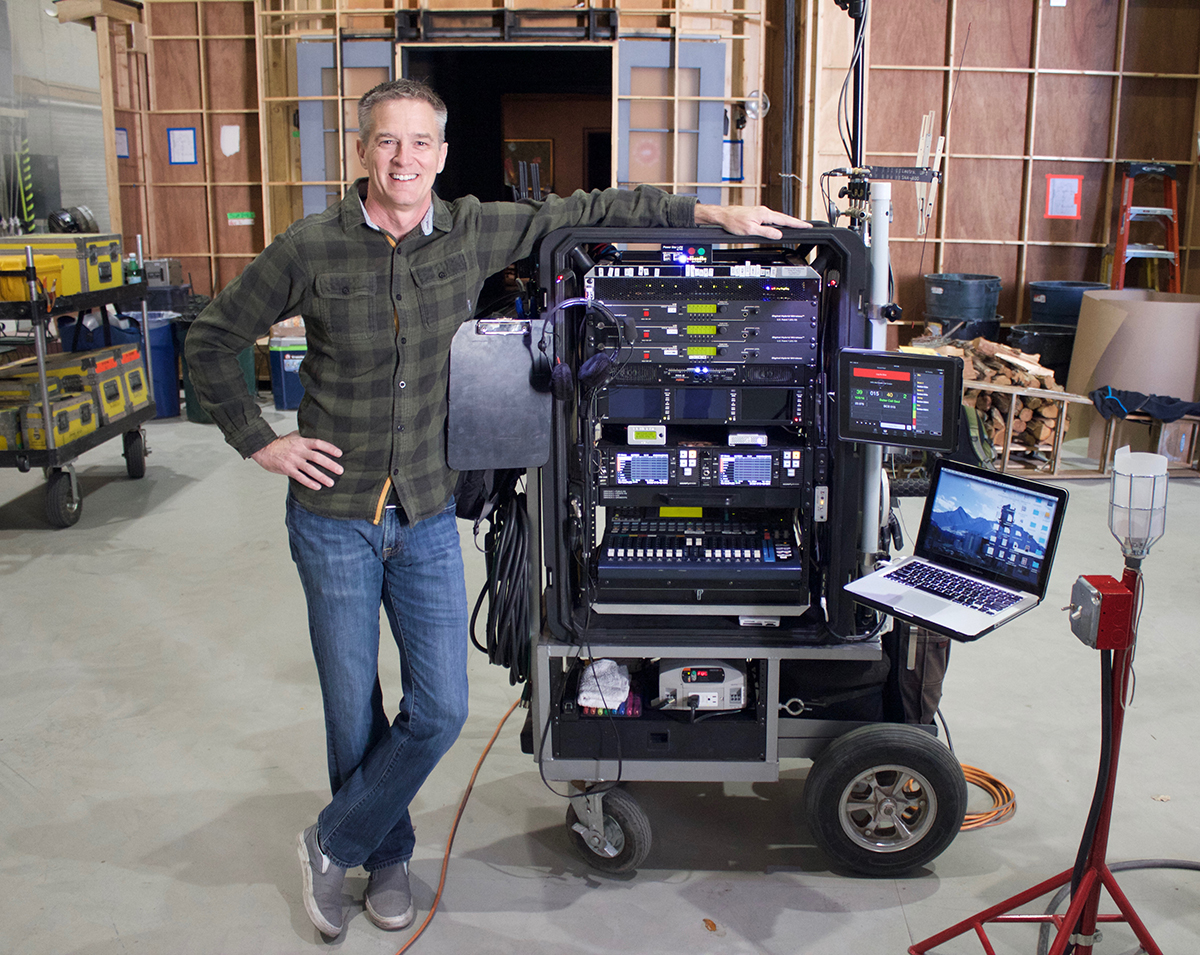
Production sound mixer Phillip W. Palmer가 제작 공간의 sound cart 옆에 서 있다. 여러 화면과 recorder, mixing surface, 케이블과 노트북이 한 사람의 작업 자리로 묶여 있다. Metadata 입력 순간이나 특정 작품을 증명하지 않는다.SOURCE: SOUND DEVICES · NO MODIFICATIONS · · SOURCE
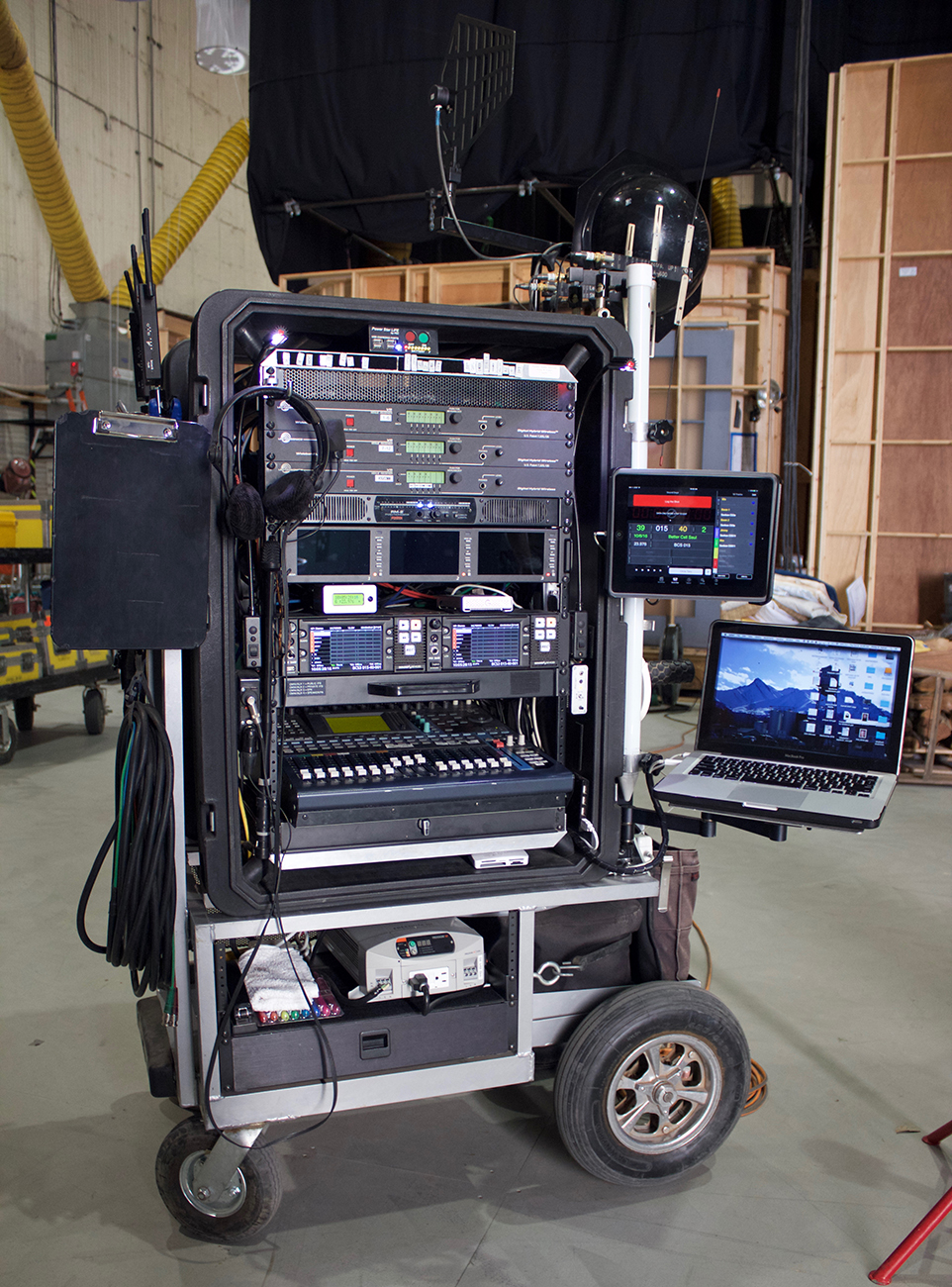
Phillip Palmer의 이동식 sound cart. rack 장비와 mixing surface, 화면과 노트북, 감긴 케이블과 바퀴가 현장에서 반복해 세우고 옮긴 작업 시스템의 흔적을 보여 준다. 화면 내용과 record 상태는 식별하지 않는다.SOURCE: SOUND DEVICES · NO MODIFICATIONS · · SOURCE
2010년, 한 TV pilot의 후반 작업실이다.
assistant editor가 하루치 sound folder를 연다. 그는 있어야 한다고 생각한 ISO track을 찾지 못하고 production sound mixer에게 연락한다.
mixer의 설명은 단순했다. 그 몇 scene에서는 microphone 하나와 track 하나만 사용했다. 파일이 사라진 것이 아니라 처음부터 더 많은 ISO가 없었다.[H056-04]
ATTRIBUTED USER EXPERIENCE · JWSOUND 사용자 한 명이 자신의 TV pilot 경험을 쓴 사례다. 작품명과 assistant editor의 입장, 실제 report의 상태는 확인되지 않는다. 한 사람의 혼란을 업계 전체나 한 직무의 숙련도 문제로 확대하지 않는다.[H056-04]
파일 안에 이름이 있는데 왜 전화가 왔나
BEXT의 자유 서술 칸에 제작 정보를 제각각 적는 방식은 받은 쪽이 같은 뜻으로 읽기 어려웠다. iXML은 production, telecine, picture editorial, audio post 사이에서 file과 project metadata를 더 분명하게 주고받기 위해 만들어졌다.[H056-01]
SCENE, TAKE, NOTE, TRACK NAME 같은 현장의 명사뿐 아니라 같은 recording에 속한 파일 관계를 담을 자리가 생겼다.[H056-02] 788T는 BEXT와 iXML을 함께 기록했고, 배우나 mic를 설명하는 track name이 숫자보다 editor에게 유용하다고 설명했다.[H056-03]
현장의 명사를 구조화했다
production sound mixer는 scene·take와 track name, notes가 실제 촬영을 가리키는지 확인했다. crew가 큰 제작에서는 다른 sound team 구성원이 배우·lav·wireless·timecode와 clerical 정보를 보조할 수 있었지만, metadata 입력과 report 작성의 분담은 제작마다 달랐다.
assistant editor는 embedded metadata로 파일을 정리하고 report로 하루 전체와 예외를 읽었다. 같은 take가 여러 mono 파일로 나뉘어도 관계를 다시 찾을 단서가 생겼고, note에는 TAIL SLATE, NO SLATE, PLANE OVERHEAD처럼 파형만으로 알기 어려운 이유를 적을 수 있었다.[H056-02]
모든 칸은 optional이었다
중요한 한계는 iXML의 모든 field가 optional이었다는 점이다. reader는 어떤 field가 반드시 있다고 가정할 수 없었다.[H056-01] software가 BEXT나 iXML을 알아보지 못하면 오디오는 열려도 추가 정보는 조용히 무시될 수 있었다.[H056-03]
track 이름도 실제 mic 배치가 바뀌면 사람이 고쳐야 했다. 잘못 적힌 값은 구조화된 채로 멀리 갈 수 있었다. comprehensive metadata가 있어도 descriptive filename은 후반에서 여전히 유용하다고 Wave Agent 설명서는 적었다.[H056-05]
iXML은 사람이 붙인 이름과 관계를 파일 안에서 더 멀리 운반했다. 없는 track과 누락된 track을 구분하고, note의 뜻을 실제 촬영과 맞추는 일은 report와 대화에 남았다.
다음 스프레드는 track 수가 늘면서 이 책임이 어떻게 커졌는지 788T와 ISO track의 작업에서 이어 간다.
EVIDENCE CONTEXT
이 페이지에서 사용한 근거
본문의 서사는 유지하고, 각 출처가 확인하는 내용과 한계를 먼저 보여 준다. English 원문과 출처는 펼쳐 확인할 수 있다.
H056-01
문맥 이해Gallery UK의 specification introduction은 iXML이 production부터 audio post까지 file·project metadata를 명확히 전달하도록 설계됐고 모든 field가 optional이라고 명시한다. 누적 specification의 목적과 생성 규칙이므로 개별 recorder·reader가 어떤 field를 실제 작성·보존했는지는 확정하지 않는다.
원문·출처 보기
other
iXML Specification — Introduction
The iXML specification is designed to provide an unambiguous communication of file and project based metadata between various stages of workflow in production, telecine, picture editorial and audio post production.
All fields are optional when creating iXML, and readers of iXML data must not assume or require any fields to be present.
원문 열기Gallery UK · publication date not stated; current page includes a 2019 update
H056-02
문맥 이해Gallery UK의 object reference는 file origin을 추적하는 HISTORY, 한 recording의 file을 연결하는 FAMILY_UID, 현장 예외를 적는 NOTE의 용도를 정의한다. 이 object들은 관계와 기록 자리를 제공할 뿐 값의 입력·정확성·수신 software의 해석을 보증하지 않는다.
원문·출처 보기
other
iXML Specification — Individual Object Details
The HISTORY object allows tracking of a file’s origins, where it may have been created as a derivation of another file.
Multiple Files which represent a single recording should share a common FAMILY_UID so they can be associated.
A free text note to add user metadata to the recording. This might typically used to communicate information such as TAIL SLATE, NO SLATE, or to warn of noise interruptions - PLANE OVERHEAD etc.
원문 열기Gallery UK · publication date not stated; cumulative specification reference
H056-03
문맥 이해Sound Devices의 v3.02 guide는 788T Broadcast Wave file에 iXML과 bEXT data가 포함되고 이를 인식하지 못하는 application에서는 정보가 무시되며 descriptive track name이 editor에게 더 유용할 수 있다고 설명한다. 2014년 누적 guide이므로 이 기능 전체를 2008년 첫 출하 상태로 소급하거나 이름의 실제 mic·배우 대응이 자동 검증됐다고 볼 수 없다.
원문·출처 보기
manual
788T User Guide and Technical Information, Version 3.02
788T Broadcast wave files include iXML (revision 1.5) data and bEXT chunk data.
For applications that don’t recognize bEXT or iXML, this information is ignored.
Descriptive track names such as ‘radio mic 1’, ‘boom 2’ or ‘John Smith’ are more helpful to editors than track numbers.
원문 열기Sound Devices · Version 3.02; matching firmware released 2014-05-27
H056-04
문맥 이해JWSOUND thread에서 확인되는 범위는 한 production mixer가 TV pilot의 assistant editor에게서 ISO 문의를 받았고 해당 scene들에는 microphone 하나와 track 하나만 사용됐다는 당사자 기록이다. 이 단일 forum 기록만으로 다른 assistant editor의 숙련도나 metadata·report의 일반적 신뢰도는 확인할 수 없다.
원문·출처 보기
practitioner recollection
Talk about Sound Reports
I got a panicked call from the assistant editor on the TV pilot I did saying that she couldn't find the iso tracks.
It turns out that she was looking for all the isos for several scenes where we only used 1 microphone and 1 track.
문맥 이해Wave Agent Beta 1.2 guide는 한 take가 polyphonic file 하나이거나 sibling mono file 묶음이어도 한 row로 표시하고 comprehensive metadata가 있어도 descriptive filename이 유용하다고 밝힌다. 발행일이 인쇄되지 않은 beta 문서이므로 2010년 Wave Agent 1.15와 같은 version이거나 모든 post workflow를 대표한다고 확정할 수 없다.
원문·출처 보기
manual
Wave Agent Beta 1.2 User Guide and Technical Information
The Take List displays files by rows, with each row representing one take, whether or not that take is made up of a single, polyphonic file or a group of multiple monophonic files (siblings).
WAV files with descriptive file names are useful in Post Production, even with comprehensive metadata available in a Broadcast WAV file.
원문 열기Sound Devices · Software Revision 1.2; publication date not printed
H056-01 · H056-02 · H056-03 · H056-04 · H056-05
03 · MULTITRACK · ONE PERSON, MORE SIGNALS057
057
MULTITRACK · ONE PERSON, MORE SIGNALS
트랙이 늘자, 믹서는 무엇을 더 들어야 했을까
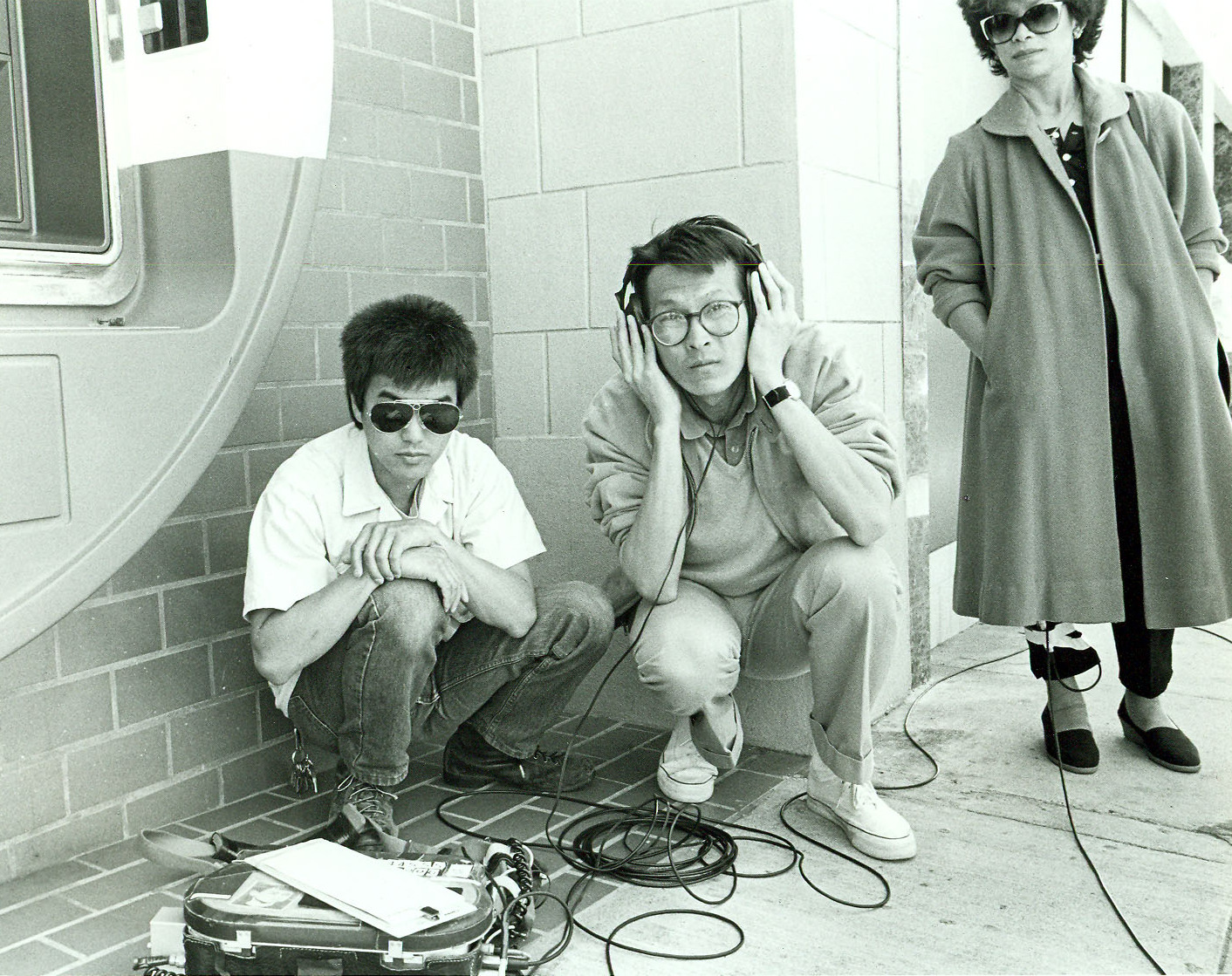
1983년 San Francisco의 영화 《Dim Sum: A Little Bit of Heart》 로케이션. 왼쪽에 sound recordist Curtis Choy가 앉아 있다. 788T보다 앞선 장면이며 digital multitrack이나 ISO track을 보여 주는 사진이 아니다.PHOTO: NANCY WONG · CC BY-SA 3.0 · DISPLAY CROP · SOURCE · CC BY-SA 3.0
1983년, San Francisco의 한 로케이션이다.
왼쪽에 sound recordist Curtis Choy가 앉아 있고, 중앙의 Wayne Wang은 헤드폰을 썼다. 발밑에는 케이블과 녹음 장비가 놓여 있다. 이 사진은 788T보다 앞선 시대에도 현장 소리가 사람의 귀와 판단을 통과했다는 사실만 보여 준다.
HISTORICAL CONTEXT · Commons의 사진 설명에 따른 인물·작품·장소 식별이다. 사진만으로 당시 recorder 모델이나 track 구성을 특정하지 않는다.
한 장면의 마이크가 여러 개로 늘면, 믹서는 그만큼 더 많이 들을 수 있었을까?
더 많은 트랙은 더 많은 귀가 아니었다
멀티트랙 녹음은 788T에서 시작되지 않았다. 1970년대 영화 작업에서 Jim Webb는 각 무선 마이크가 작동하는지 먼저 확인했다. 그러나 모든 신호를 한꺼번에 들을 수 없어 촬영 중에는 미터를 봤다고 회고했다.[H058-03]
그의 경험에서는 가까운 무선 마이크 위주로 들으면 화면 거리와 맞지 않는 소리가 됐고, 후반은 여러 트랙을 정리하는 데 더 많은 시간을 써야 했다.[H058-03] 더 많이 기록해도 한 사람이 동시에 더 많이 들을 수 있는 것은 아니었다.
여덟 입력을 현장 믹스와 개별 트랙으로 나눠 남겼다
2008년 등장한 788T에는 여덟 개의 입력이 있었다. 각 입력은 현장 믹스와 개별 ISO 트랙으로 연결할 수 있었고, 두 결과를 동시에 기록할 수 있었다.[H057-05]
Pre-fade ISO는 입력 trim 뒤, 믹스 fader 앞에서 신호를 받는다. 개별 ISO 트랙의 기록 설정이 갖춰져 있다면, 현장 믹스에서 한 마이크를 잠시 낮춰도 그 신호는 pre-fade 트랙에 계속 남길 수 있었다.[H057-06]
788T가 처음 출하됐을 때부터 12-track recorder였던 것은 아니다. Sound Devices는 초기 기능이 제한적이었다고 회고하며, 12-track recording은 뒤이은 firmware에서 추가됐다.[H057-02][H057-03]
선택권과 함께 감시할 것도 늘었다
한 TV 시리즈의 현장 믹서 Beau Baker는 등장인물이 많아지던 시기에 788 계열로 옮겨 two mix와 six ISO를 기록했다고 회고한다.[H057-08] 한 제작의 구성이지 모든 현장의 표준은 아니다.
Simon Hayes는 ISO 트랙이 늘면서 fader mix 외에도 입력 gain과 여러 변수를 더 많이 감당하게 됐다고 썼다.[H057-09]
편집 해석 · 788T가 넓힌 것은 한 사람의 귀가 아니라, 같은 연기에서 현장 믹스와 ISO를 함께 남길 선택이었다. 그 선택을 실제 파일로 만드는 일은 여전히 사람의 듣기와 확인에 달렸다.
EVIDENCE CONTEXT
이 페이지에서 사용한 근거
본문의 서사는 유지하고, 각 출처가 확인하는 내용과 한계를 먼저 보여 준다. English 원문과 출처는 펼쳐 확인할 수 있다.
H057-02
문맥 이해Sound Devices의 후대 회고는 788T를 NAB에서 선보인 뒤 출하했고 초기 기능은 비교적 제한적이었다고 기록한다. 회사 회고는 정확한 첫 출하일이나 각 기능의 최초 상태를 모두 제공하지 않으므로 dated firmware record를 대신할 수 없다.
원문·출처 보기
official retrospective
788T: the beast arrives! – 2008
we were able to show the 788T at NAB and start shipping.
The 788T you all know and love was fairly spartan — feature-wise — at first
원문 열기Sound Devices · retrospective publication date not stated; concerns the 2008 launch
H057-03
문맥 이해공식 firmware history는 v1.60에서 12-track recording과 L·R·X1·X2 post-fader mixing, 12-track BEXT·iXML support를 추가했다고 기록한다. 이 release에는 세 recording media 동시 사용 시 8-track 제한이 있었으므로 이후 상태나 모든 설정의 12-track 기록으로 확대할 수 없다.
원문·출처 보기
other
788T & 788T-SSD Firmware History — v1.60
12-track recording (limited to 8-tracks when recording to 3 simultaneous record media)
Post-fader mixing to L, R, Aux1 (X1) and Aux 2 (X2) tracks
문맥 이해공식 guide는 input을 임의의 track으로 route해 ISO와 submix를 동시에 기록할 수 있고 track은 input의 destination이라고 정의한다. v3.02 누적 guide의 routing 설명이므로 2008년 최초 firmware의 상태나 실제 제작에서 선택한 경로를 확정하지 않는다.
원문·출처 보기
manual
788T User Guide v3.02 — Input to Track Routing
Any input can be routed to any track. With this powerful routing, iso tracks and sub-mixes can be recorded simultaneously.
Tracks are destinations for inputs, they can be routed to outputs and/or selected for recording.
원문 열기Sound Devices · Version 3.02; matching firmware released 2014-05-27
H057-06
문맥 이해공식 guide는 pre-fade track이 trim stage 직후 신호를 받고 fader adjustment의 영향을 받지 않으며 post-fade track은 fader stage 뒤 신호를 받는다고 구분한다. 이 signal-path 구분은 pre-fade ISO가 preamp·trim·filter·limiter 등 어떤 처리도 거치지 않은 원음이라는 뜻은 아니다.
원문·출처 보기
manual
788T User Guide v3.02 — Pre-Fade vs. Post Fade
Pre-fade tracks are fed the respective input’s audio signal immediately following the Trim level stage of the signal path. Fader adjustments have no effect on pre-fade Tracks.
Post-fade tracks are fed the respective input’s audio signal immediately following the Fader level stage of the signal path.
원문 열기Sound Devices · Version 3.02; matching firmware released 2014-05-27
H057-08
문맥 이해Beau Baker의 장기 제작 회고는 네 번째 season에 788 계열로 옮겨 boom ISO와 일부 wireless를 포함한 two mix·six ISO 구성을 썼고 장면 인원이 늘었다고 설명한다. 한 TV production의 개인 회고이므로 모든 drama의 track 구성이나 cast 증가와 장비 선택의 보편 인과를 확정하지 않는다.
원문·출처 보기
practitioner recollection
Is That Show Still On?
By the fourth season, I upgraded to a Sound Devices 788, with the DVD-RAM burner connected to it.
My mix now included Boom ISO tracks and some wireless tracks.
I could now record six iso tracks with the two mix tracks.
five more actors were cast as interns. A couple of new attending doctors were cast, so the scenes were more and more populated.
원문 열기IATSE Local 695 · publication date not stated; retrospective on Grey’s Anatomy
H057-09
문맥 이해Simon Hayes의 실무 essay는 dialog editor가 전달된 ISO로 production mix를 다시 구성하고 ISO가 늘면서 현장에서 다뤄야 할 변수와 후반 선택지가 함께 늘었다고 설명한다. 장편·고예산 TV 경험에 기반한 전문 실무자의 견해이므로 모든 제작에서 같은 재구성 빈도나 부담이 발생한다고 일반화할 수 없다.
원문·출처 보기
practitioner recollection
How Important Is the Production Mix?
the Dialog Editor will generally rebuild the production sound mix from the component ISO tracks I deliver.
With the additional ISO tracks we record, there is so much more we are having to cope with.
We are having to react to so many more variables during a take than purely mixing our faders.
We are able to provide choices for the Dialog Editor and it would be arrogant to assume that we always make the right choices between the lavs and booms when we are in the moment
원문 열기IATSE Local 695 · publication date not stated
H058-03
문맥 이해Jim Webb의 역사적 회고는 많은 radio signal을 모두 동시에 들을 수 없어 먼저 작동을 확인한 뒤 meter를 봤고 post가 여러 track을 다루는 데 추가 시간이 들었다고 설명한다. 1970년대 Altman production의 선례이며 788T 직접 근거나 모든 multitrack 촬영의 대표 사례는 아니다.
원문·출처 보기
practitioner recollection
Jim Webb: A Profile
Post work required an additional two weeks to deal with all the different tracks.
There’s no perspective. We ran into that immediately on Nashville.
And you can’t possibly listen to it all because it’s just a Tower of Babel. So once I previewed all the radios and made sure they were working, you were just watching the meters.
원문 열기IATSE Local 695 · publication date not stated; retrospective on 1970s production
2008년 IBC Amsterdam 전시대의 Sound Devices 788T. 전면 meter와 당시 eight-track 표지는 보이지만 실제 촬영, ISO arm, 12-track recording 상태를 증명하지 않는다.PHOTO: CLI · CC BY-SA 4.0 · DISPLAY CROP · SOURCE · CC BY-SA 4.0
EDITORIAL RECONSTRUCTION · 설명용 재구성이다. 촬영 직전, 현장 믹서가 미터와 트랙 상태를 차례로 확인한다. 사진은 IBC 2008 전시 장면이며 실제 촬영이나 ISO 트랙의 arm 상태를 보여 주지 않는다.
신호가 보인다는 사실과 파일에 기록된다는 사실은 같지 않다. 입력이 켜져 있고, 신호가 기록할 트랙으로 연결됐으며, 트랙 기록이 활성화되고, 해당 트랙의 저장 매체가 지정돼야 한다.[H058-01]
후반이 개별 마이크를 다시 고를 수 있다면, 현장 믹스는 임시 파일에 불과해졌을까?
믹스는 지금을, ISO는 다음 판단을 위해
Simon Hayes의 경험에서는 대사 편집자가 개별 ISO 트랙으로 현장 믹스를 다시 구성하는 일이 흔했다.[H057-09] 그렇다고 현장 믹스가 사라진 것은 아니다. 촬영 당일 편집과 감독의 판단에는 장면을 바로 들려줄 믹스가 필요했다.
ISO는 다른 시간의 결과물이었다. 완성된 편집에서 붐과 라발리에 마이크의 거리감을 다시 고르고, 다른 take의 단어나 음절을 쓰며, 개별 noise를 다룰 재료가 됐다.[H058-02]
현장 믹서는 배우의 움직임과 프레임을 보며 지금 들을 균형을 만들었다. 후반의 대사 편집자는 조용한 작업실에서 완성된 화면을 반복해 보며 ISO를 다시 비교할 수 있었다. 두 판단은 경쟁 관계가 아니었다.
최대 숫자보다 조건이 먼저였다
12-track recording은 2008년 11월 26일 firmware v1.60에서 추가됐다. 다만 이 버전은 세 저장 매체에 동시에 기록할 때 최대 8-track으로 제한됐다.[H057-03] 2009년 2월 10일 v1.65부터 48 kHz에서는 12-track을 세 저장 매체에 기록할 수 있었다. 88.2/96 kHz에서는 최대 8-track·두 저장 매체였다.[H057-04]
기록되지 않은 선택은 되돌릴 수 없다
ISO가 있어도 기록되지 않은 신호는 되살릴 수 없다. 꺼진 입력, 연결되지 않은 신호, 기록이 활성화되지 않은 트랙, 저장 매체에 할당되지 않은 트랙은 파일에 남지 않는다.[H058-01]
2009년 firmware v1.76 환경에서 788T/CL-8을 reality rig로 쓴 Chris Durfy는 사용하지 않는 track을 꺼 전력을 아끼는 방법과, 출연자가 갑자기 돌아올 때를 대비해 켜 두는 방법 사이의 타협을 기록했다.[H058-04] 특정 rig와 초기 firmware의 경험이므로 제품 전체의 고정 특성으로 일반화하지 않는다.
편집 해석 · ISO는 현장 믹스를 대신하지 않았다. 현장 믹서는 그 순간의 균형을 남겼고, ISO는 후반이 다시 고를 재료를 남겼다. 다만 기록되지 않은 신호는 후반의 선택지가 될 수 없었다.
현장 믹서는 지금의 장면을 섞었다. 대사 편집자는 나중의 장면을 ISO에서 다시 골랐다. 둘 사이를 연결한 것은 더 많은 트랙이 아니라, 어떤 신호를 남겼는지 확인한 사람의 책임이었다.
다음 스프레드는 이 트랙들이 촬영 정보와 함께 후반에 도착하도록 확인하는 사람의 일을 따라간다.
EVIDENCE CONTEXT
이 페이지에서 사용한 근거
본문의 서사는 유지하고, 각 출처가 확인하는 내용과 한계를 먼저 보여 준다. English 원문과 출처는 펼쳐 확인할 수 있다.
H057-03
문맥 이해공식 firmware history는 v1.60에서 12-track recording과 L·R·X1·X2 post-fader mixing, 12-track BEXT·iXML support를 추가했다고 기록한다. 이 release에는 세 recording media 동시 사용 시 8-track 제한이 있었으므로 이후 상태나 모든 설정의 12-track 기록으로 확대할 수 없다.
원문·출처 보기
other
788T & 788T-SSD Firmware History — v1.60
12-track recording (limited to 8-tracks when recording to 3 simultaneous record media)
Post-fader mixing to L, R, Aux1 (X1) and Aux 2 (X2) tracks
문맥 이해공식 firmware history는 v1.65에서 48 kHz의 track·media count 제한을 풀어 12-track을 세 media에 기록할 수 있게 했고 88.2·96 kHz는 최대 8-track·두 media로 기록했다고 명시한다. 이는 해당 release의 조건이며 모든 sample rate에서 12-track·세 media를 보장하지 않는다.
원문·출처 보기
other
788T & 788T-SSD Firmware History — v1.65
Removed the limitation on track/media count at 48 kHz recording. 12 track, 48 kHz audio can now be recorded to 3 media simultaneously.
Sampling rates of 88.2 kHz and 96 kHz, for up to 8-track recording to 2 media simultaneously.
문맥 이해공식 firmware history는 v2.18에서 factory default input-to-track routing이 two mix와 eight ISO, ten armed tracks로 바뀌었다고 기록한다. 공장 기본값의 변경일 뿐 모든 version·사용자·촬영이 이 구성을 유지했다는 증거는 아니다.
원문·출처 보기
other
788T & 788T-SSD Firmware History — v2.18
Factory default input-to-track routing changed to ‘2 mix (L,R), 8 Iso (A-H)’ with 10 tracks armed.
문맥 이해Simon Hayes의 실무 essay는 dialog editor가 전달된 ISO로 production mix를 다시 구성하고 ISO가 늘면서 현장에서 다뤄야 할 변수와 후반 선택지가 함께 늘었다고 설명한다. 장편·고예산 TV 경험에 기반한 전문 실무자의 견해이므로 모든 제작에서 같은 재구성 빈도나 부담이 발생한다고 일반화할 수 없다.
원문·출처 보기
practitioner recollection
How Important Is the Production Mix?
the Dialog Editor will generally rebuild the production sound mix from the component ISO tracks I deliver.
With the additional ISO tracks we record, there is so much more we are having to cope with.
We are having to react to so many more variables during a take than purely mixing our faders.
We are able to provide choices for the Dialog Editor and it would be arrogant to assume that we always make the right choices between the lavs and booms when we are in the moment
원문 열기IATSE Local 695 · publication date not stated
H058-01
문맥 이해공식 guide는 record-enabled 상태와 active routed input을 함께 갖춘 armed track만 기록한다고 설명한다. 이 조건 설명은 meter에 보이는 signal이 자동으로 file에 남거나 누락된 track을 나중에 복구할 수 있다는 뜻이 아니다.
원문·출처 보기
manual
788T User Guide v3.02 — Track Arming
The 788T only records tracks that are armed. Armed tracks are tracks that are both record enabled and have active inputs routed to them.
원문 열기Sound Devices · Version 3.02; matching firmware released 2014-05-27
H058-02
문맥 이해Simon Hayes의 실무 essay는 ISO component로 이전 take의 단어나 음절을 쓰거나 배경 noise를 다루고 lavalier ISO로 scene을 다시 mix할 수 있는 후반 선택을 설명한다. 이러한 선택지는 실제로 기록된 usable ISO에 한정되며 RF dropout·의상 마찰·잘못된 gain·미기록 track을 복구한다는 보증은 아니다.
원문·출처 보기
practitioner recollection
How Important Is the Production Mix? — ISO choices in post
Rebuilding the mix using the ISO components allows the Dialog Editor and the Re-recording Mixer the opportunity to ‘steal’ words or even syllables from previous takes to help performance, or remove unwanted background noise that is unfilterable.
the Dialog Editor has the ability to completely remix the first scene with the lavalier ISO tracks to intercut seamlessly with the second scene.
원문 열기IATSE Local 695 · publication date not stated
H058-04
문맥 이해Chris Durfy의 2009년 forum 기록은 track을 꺼 전력을 줄이는 선택과 출연자의 갑작스러운 복귀에 대비해 channel을 켜 두는 workaround 사이의 타협을 보고한다. 특정 reality bag rig와 초기 firmware의 개인 경험이므로 모든 788T의 고정 전력·출력 특성으로 일반화할 수 없다.
원문·출처 보기
practitioner recollection
Top 10 Issues with using a Sound Devices 788T / CL-8 in a Reality Rig
Simply put, the 788t likes the juice.
It is advisable to turn off tracks you are not using to help reduced the power drain.
If you are turning on/off tracks to save battery/recording space, be aware that the ALL source outputs will be interrupted for about a second while the channel powers up.
The workaround is to NOT turn off a channel, and just the coarse gain down if there is a chance a cast member might come back into scene.
두 사람이 노트북과 작은 믹서, 헤드폰이 놓인 작업 공간에 있다. 앞쪽 인물은 화면을 보고, 뒤쪽 인물은 전화기를 귀에 대고 있다. 이 사진은 production sound 파일의 인계나 report 대조를 증명하지 않는다.PHOTO: ARLIE CARSTENS / INCASE. · CC BY 2.0 · DISPLAY CROP · SOURCE · CC BY 2.0
EDITORIAL RECONSTRUCTION · 2011년 무렵 마지막 take가 끝난 sound cart를 설명용으로 재구성했다. 사진은 별도의 편집 작업 공간이며 production sound 인계나 report 대조를 증명하지 않는다.
production sound mixer가 recorder의 scene과 take를 읽는다. 제작에서 정한 촬영 기록과 recorder의 이름이 같은 장면을 가리키는지 확인한다.
recorder의 scene·take, 촬영 기록, 후반의 clip 이름은 어떻게 같은 장면을 가리켰을까?
report가 하루 folder 가까이 들어왔다
2011년 8월 공개된 788T firmware v2.15에는 기존 audio folder에서 CSV sound report를 만들고 header를 사용자화하는 기능이 추가됐다.[OFFICIAL:H060-01] 후대 v3.02 guide의 report는 folder 안 take를 행으로 펼쳐 각 take의 정보를 사람이 읽는 칸으로 보여 준다.[OFFICIAL:H060-02]
중요한 기술 개념은 folder 단위 sound report다. report가 folder마다 만들어졌기 때문에 하루치 delivery를 쓰는 제작은 folder 경계와 실제 인계할 하루의 경계를 맞춰야 했다. guide의 daily folder는 설정 예시이지 모든 제작의 유일한 표준은 아니다.[OFFICIAL:H060-03]
같은 이름을 세 사람이 이어 읽었다
House of Cards workflow의 후대 회고에서 production sound mixer Lorenzo Millan은 episode·scene·take 번호를 script supervisor Robb Foglia와 맞췄고, assistant picture editors는 그 file name을 clip 이름에 사용했다고 설명했다.[HUMAN:H059-04] 이 제작의 특수 workflow를 모든 제작의 규칙으로 확대하지 않는다.
Scott D. Smith는 2012년에 file·timecode·naming 규칙을 촬영 전에 editorial과 합의하고 post-production의 요구를 문서로 받으라고 권했다.[HUMAN:H059-05] 종이 log가 audio file과 떨어지지 않도록 digital log를 함께 두라는 권고도 남겼다.[HUMAN:H059-06]
report 생성은 정확성과 도착을 보증하지 않았다
CSV가 만들어졌다는 사실은 입력된 scene·take·track name이 실제 촬영과 맞거나, report가 media와 함께 수령자에게 도착했다는 뜻이 아니다. 잘못 입력한 이름도 그대로 펼쳐질 수 있었다.
편집 해석 · sound report는 여러 파일의 이름과 예외를 하루의 맥락으로 묶어 다음 사람이 다시 읽게 하는 약속이었다. 장비는 목록을 만들 수 있었지만, 그 목록이 실제 촬영과 맞고 audio와 함께 도착하게 하는 일은 사람 사이에 남았다.
EVIDENCE CONTEXT
이 페이지에서 사용한 근거
본문의 서사는 유지하고, 각 출처가 확인하는 내용과 한계를 먼저 보여 준다. English 원문과 출처는 펼쳐 확인할 수 있다.
HUMAN:H059-04
문맥 이해Lorenzo Millan의 후대 회고는 House of Cards에서 episode·scene·take를 script supervisor Robb Foglia와 맞췄고 assistant picture editors가 그의 file name을 clip에 썼다고 설명한다. slate를 쓰지 않은 한 제작의 workflow이므로 모든 2012년 또는 Netflix production의 표준이나 metadata 무오류를 증명하지 않는다.
원문·출처 보기
practitioner recollection
House of Cards
We don’t use slates on HOC. Everything is linked by timecode and metadata.
The workflow begins with my metadata; episode, scene and take numbers in tight collaboration with our Script Supervisor, Robb Foglia.
The Assistant Picture Editors use my file name for the clips.
원문 열기IATSE Local 695 · publication date not stated; retrospective on a production begun in 2012
HUMAN:H059-05
문맥 이해Scott Smith의 2012년 실무 글은 production 전에 convention을 합의하고 editorial 또는 post-production의 요구를 문서로 받으라고 권한다. 한 production mixer의 권고이므로 법적·노조 표준이나 모든 제작에서 editorial이 일방적으로 규칙을 정했다는 근거는 아니다.
원문·출처 보기
practitioner recollection
Digital Asset Management for Sound — naming agreement
Therefore, it is vitally important that an agreed-upon set of conventions be established prior to production, and be adhered to throughout the run of the show.
Typically, these specifications will be supplied by editorial.
At the very least, it is important to get the required information supplied in writing from post-production.
문맥 이해Smith의 실무 글은 paper log가 data file과 분리되거나 늦게 도착할 수 있어 digital log를 audio files와 함께 두라고 권한다. 이는 한 실무자의 제안이며 digital log가 embedded metadata를 대체하거나 모든 분리·누락을 막는다는 측정 근거는 아니다.
원문·출처 보기
practitioner recollection
Digital Asset Management for Sound — digital logs
We still need to submit a sound report, whether as a paper log or digital file.
If paper logs are delivered, they frequently get separated from the data files during post-production (or get delivered after the fact).
To keep yourself from being a victim of this scenario, it is helpful to provide a digital log of some sort along with audio files
No matter what route you choose, having a log file kept with the media will always be appreciated by the folks in post.
문맥 이해공식 firmware history는 v2.15에서 기존 audio folder의 CSV sound report 생성과 header customization을 추가했다고 기록한다. 이 release note는 2008년 최초 출하 때부터 기능이 있었거나 생성된 report의 값·전달·수령이 정확했음을 보증하지 않는다.
원문·출처 보기
other
788T & 788T-SSD Firmware History — v2.15 CSV Sound Report
Ability to create CSV sound reports for any existing folder of audio files on any or all recorded media.
Ability to customize Sound Report headers in the new File: Sound Report menu.
문맥 이해공식 v3.02 guide는 sound report를 Take List와 Overview로 나누고 Take List의 각 row가 해당 folder의 take metadata에 대응한다고 설명한다. 2014년 누적 guide의 folder 기준 schema이므로 하루·project·모든 media를 자동 통합하거나 metadata가 실제 촬영과 일치함을 독립 검증한다고 볼 수 없다.
원문·출처 보기
manual
788T/788T-SSD User Guide v3.02 — CSV Sound Reports
A sound report consists of two sections: A Take List section which provides information for each take in the folder the sound report was generated in, and an Overview section that contains ancillary information to the Take List section.
Each row of this section corresponds to a take, and each field corresponds directly to the metadata of that take (BEXT and iXML).
원문 열기Sound Devices · Version 3.02; matching firmware released 2014-05-27
OFFICIAL:H060-03
문맥 이해공식 guide는 report가 folder 단위로 생성되고 각 media에 만든 report가 설정에 따라 primary media 정보에서 파생될 수 있어 Track-to-Media 구성이 다르면 적합하지 않을 수 있다고 경고한다. 이 passage는 각 media의 실제 track set을 독립 inventory한 완전한 report나 모든 제작의 daily-folder 표준을 보증하지 않는다.
원문·출처 보기
manual
788T/788T-SSD User Guide v3.02 — Folder Sound Reports
Using the STOP + MENU shortcut to create a sound report on each media will create a report that derives information from the primary media depending on what is selecting in REC: MEDIA SELECT.
This method might not be preferred if different tracks are routed to different media with Track-to-Media routing.
Since sound reports on the 788T are generated per folder,
원문 열기Sound Devices · Version 3.02; matching firmware released 2014-05-27
dbc sound의 후반 음향 시설에서 두 학생이 각자 콘솔과 화면 앞에 앉아 있다. 특정 파일의 인계나 검증 장면은 아니다.PHOTO: VANCOUVER FILM SCHOOL · CC BY 2.0 · DISPLAY CROP · SOURCE · CC BY 2.0
EDITORIAL RECONSTRUCTION · 2012년 무렵 하루 촬영 뒤, file과 sound report가 제작이 지정한 수령자를 거쳐 후반에 도착하는 장면을 설명용으로 재구성했다. 사진 속 두 학생은 dbc sound의 작업석에 있지만 특정 자료의 전달이나 확인을 보여 주지는 않는다.
후반의 사람이 하루치 audio folder와 report를 나란히 연다. 파일 이름, take의 note, 빠진 항목과 다른 track 구성을 보고, 전달 기록에 남은 예외를 다시 묻는다.
file과 sound report, 받는 사람에게 남긴 예외는 어떻게 하나의 하루치 delivery로 함께 도착했을까?
파일 목록만으로는 하루의 맥락이 완성되지 않았다
후대 v3.02 guide의 sound report는 take마다 scene, take, start timecode, duration, track name과 note 같은 칸을 사람이 읽는 목록으로 펼쳤다.[OFFICIAL:H060-02] report는 후반이 여러 파일을 하루의 순서와 촬영 맥락 안에서 다시 읽을 표면이었다.
그러나 실제로 건너간 파일 묶음은 장비 설정에 따라 달라질 수 있었다. 2009년 firmware v1.71의 Track-to-Media는 같은 recording에서도 매체마다 서로 다른 track 조합을 기록할 수 있게 했다.[OFFICIAL:H060-05] 따라서 여러 매체에 동시에 기록됐다는 사실만으로 각 매체를 동일한 복제본이라고 가정할 수 없었다.
건네는 책임과 받았다는 기록을 먼저 정했다
2012년 Smith는 여러 사람이 audio file을 다루는 과정에서 backup 책임이 업무 사이로 사라질 수 있다며, 담당자와 mixer에게 기대하는 일을 정확히 정하라고 권했다.[HUMAN:H060-01] 이 권고는 특정 직책을 모든 제작의 담당자로 고정하지 않는다.
그는 production office에 file을 넘길 때 recipient의 수령 서명을 받아 chain of custody를 남기라고도 권했다.[HUMAN:H060-02] 이는 보편적인 법정 양식의 증거가 아니라, 누가 언제 받았는지 기록해 다음 질문의 상대를 잃지 않게 하자는 실무 권고였다.
하루치 delivery는 세 가지를 함께 보냈다
Smith는 종이 log가 audio와 떨어지거나 늦게 도착하는 문제를 지적하며 digital log를 audio files와 함께 두라고 권했다.[HUMAN:H059-06] 이 페이지가 묶는 하루치 delivery는 audio file + sound report + recipient/exception context다.
후반의 확인은 파일 개수만 세는 일이 아니었다. report의 이름·note·예외가 실제로 도착한 파일과 맞는지 보고, 다른 track 구성이나 누락처럼 설명이 필요한 항목을 전달 기록의 상대에게 다시 물을 수 있어야 했다.
후대 문서는 비교 기준일 뿐이었다
나중의 best practice다. Netflix의 production sound 문서는 하루 말 captured sound와 PDF/CSV sound report를 DIT 또는 Data Manager에게 함께 넘기라고 권한다.[HUMAN:H060-10] 문서 자체가 requirement가 아니며, 이 직책이나 절차를 2008–2012의 모든 제작에 소급하지 않는다.
편집 해석 · 하루의 delivery는 파일만 이동시키는 일이 아니었다. sound report와 수령·예외 맥락을 함께 보내야 후반의 사람이 이름·note·예외를 같은 날의 기록으로 확인하고, 모르는 것을 다시 물을 수 있었다.
EVIDENCE CONTEXT
이 페이지에서 사용한 근거
본문의 서사는 유지하고, 각 출처가 확인하는 내용과 한계를 먼저 보여 준다. English 원문과 출처는 펼쳐 확인할 수 있다.
HUMAN:H059-06
문맥 이해Smith의 실무 글은 paper log가 data file과 분리되거나 늦게 도착할 수 있어 digital log를 audio files와 함께 두라고 권한다. 이는 한 실무자의 제안이며 digital log가 embedded metadata를 대체하거나 모든 분리·누락을 막는다는 측정 근거는 아니다.
원문·출처 보기
practitioner recollection
Digital Asset Management for Sound — digital logs
We still need to submit a sound report, whether as a paper log or digital file.
If paper logs are delivered, they frequently get separated from the data files during post-production (or get delivered after the fact).
To keep yourself from being a victim of this scenario, it is helpful to provide a digital log of some sort along with audio files
No matter what route you choose, having a log file kept with the media will always be appreciated by the folks in post.
문맥 이해Smith의 2012년 글은 set에서 post까지 여러 사람이 file을 다루는 과정에서 backup 책임이 사라질 수 있으므로 담당자와 mixer에게 기대되는 일을 정확히 정하라고 권한다. 이 글은 backup을 항상 mixer나 특정 직책의 책임으로 고정하지 않으며 제작별 역할 배분을 규정하지 않는다.
원문·출처 보기
practitioner recollection
Digital Asset Management for Sound — backup responsibility
it is of equal importance to determine exactly who will be responsible for the task of file backups.
With so many people involved in the handling of files from the set to post-production, the area of data backup (especially of audio files) seems to get lost in the shuffle.
as a mixer, it is important to define exactly what is expected from you in relation to making file backups of daily production material.
문맥 이해Smith는 production office에 file을 넘길 때 recipient의 수령 서명을 받아 분실 시 chain of custody를 남기라고 권한다. 한 실무자의 분실 대비 제안이므로 모든 제작에 법적으로 정형화된 양식이나 동일 수령자가 있었다고 확정할 수 없다.
원문·출처 보기
practitioner recollection
Digital Asset Management for Sound — chain of custody
When delivering files to the production office, be sure to have the recipient sign to acknowledge delivery.
This will provide a clear chain of custody in situations where something gets lost.
If sending media by a courier or shipping company, it is important that you request a signature upon delivery.
문맥 이해Netflix의 후대 best-practice 문서는 매 production day 말 captured sound와 PDF 또는 CSV report를 DIT나 Data Manager에게 함께 넘기고 scripted production의 circled take를 script supervisor와 확인하라고 권한다. 문서 자체가 specification이나 delivery requirement가 아니라고 밝히므로 2008–2012 또는 모든 현대 production의 의무 절차로 소급할 수 없다.
원문·출처 보기
other
Live Action — Production Sound Best Practices
A PDF Report or a CSV file should be generated and handed off to the DIT or Data Manager with captured sound at the end of each production day.
On scripted productions, circled takes should be noted on the sound reports and confirmed with the script supervisor at each break.
This article does not provide specifications or delivery requirements and following these best practices is not required by Netflix.
원문 열기Netflix Partner Help · overhauled after 2021-12-06; current guidance
OFFICIAL:H060-02
문맥 이해공식 v3.02 guide는 sound report를 Take List와 Overview로 나누고 Take List의 각 row가 해당 folder의 take metadata에 대응한다고 설명한다. 2014년 누적 guide의 folder 기준 schema이므로 하루·project·모든 media를 자동 통합하거나 metadata가 실제 촬영과 일치함을 독립 검증한다고 볼 수 없다.
원문·출처 보기
manual
788T/788T-SSD User Guide v3.02 — CSV Sound Reports
A sound report consists of two sections: A Take List section which provides information for each take in the folder the sound report was generated in, and an Overview section that contains ancillary information to the Take List section.
Each row of this section corresponds to a take, and each field corresponds directly to the metadata of that take (BEXT and iXML).
원문 열기Sound Devices · Version 3.02; matching firmware released 2014-05-27
OFFICIAL:H060-05
문맥 이해공식 firmware history는 v1.71의 Track-to-Media가 임의의 track을 media별 조합으로 route하도록 했고 internal drive와 DVD-RAM에 서로 다른 예를 제시한다. 기능 가능성을 보여 주는 release note이므로 특정 촬영의 실제 설정이나 여러 media가 identical backup이었다는 결론을 제공하지 않는다.
원문·출처 보기
other
788T & 788T-SSD Firmware History — v1.71 Track-to-Media
Track-to-Media feature in the Track Setup Menu enables user to route any track to any media in any combination. E.g. Route MIX + ISO tracks to the internal hard drive and MIX tracks only to DVD-RAM